Zambia: The Rivalry Between Edgar Lungu and Hakainde Hichilema, Extending to the Dispute Over His Funeral

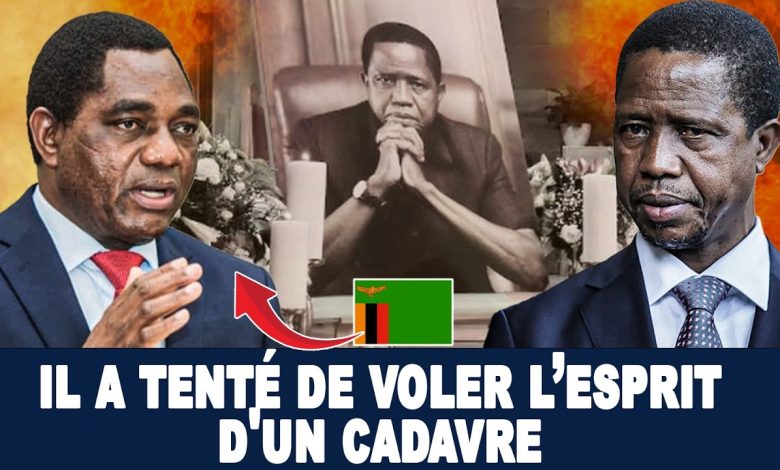
The death of Edgar Lungu, former President of Zambia, led to an exceptional confrontation between his family and the Zambian authorities. The former head of state died in South Africa in 2025 at the age of 68, and his body was not immediately repatriated for the state funeral normally expected for a president.
The central issue in the dispute was the place of burial, the presence of current authorities and control over the body. Edgar Lungu’s family refused to allow his body to be returned to Zambia under the conditions sought by the government of Hakainde Hichilema, his successor and former rival. The family notably stated that the former president did not want Hakainde Hichilema to attend his funeral.
Family members also raised fears of occult practices being performed on the body. This was an allegation and concern expressed by relatives, not an established fact based on the available information. This aspect illustrated the level of mistrust reached between the two sides.
A long-standing opposition between Edgar Lungu and Hakainde Hichilema
Edgar Lungu led Zambia from 2015 to 2021. Hakainde Hichilema succeeded him in 2021, after having long been his political opponent. Their relationship had already been marked by a major legal episode in 2017.
That year, Hakainde Hichilema was arrested and held for four months in a treason case. According to reported accounts, the case was linked to an incident involving his vehicle and the passage of Edgar Lungu’s presidential motorcade. Hakainde Hichilema was accused of failing to give way to the presidential convoy. The proceedings were later dropped.
This episode had a lasting effect on perceptions of their rivalry. When Hakainde Hichilema came to power in 2021, his government launched several investigations targeting Edgar Lungu and members of his family over suspicions of corruption and possession of assets allegedly derived from criminal activity.
Proceedings involving the former president’s family
In 2023, Tasila Lungu, described as a daughter of the former president, was arrested in a case concerning the possession of assets. Figures cited in the case referred to 69 houses and 79 vehicles, with an estimated value of $5 million. A court ruling reportedly ordered the return or recovery of these assets.
Esther Lungu, the former president’s wife, was also prosecuted over properties valued at $2 million. Reported information referred to 15 two-storey apartments and around 20 other properties covered by a court decision.
For the government in power, these proceedings were part of the fight against corruption and the enforcement of the law. For the Lungu family, they formed part of a pattern of political revenge. These two interpretations fuelled a climate of confrontation that did not ease after Edgar Lungu left the presidency.
Illness, travel restrictions and the family’s allegations
Before his death, Edgar Lungu was ill. According to the information mentioned, he suffered from complications linked to achalasia, a disease that notably affects the oesophagus. His family maintained that he had repeatedly faced difficulties or refusals when trying to travel abroad for treatment, including to India, Spain, other European countries and, at times, South Africa.
The former president’s relatives accused the authorities of delaying his medical travel for political reasons. They believed that these obstacles had contributed to his death. Some family members also suggested that a criminal act, or even poisoning, may have been involved.
These allegations were made by the family and are not presented as having been established by a court ruling in the available information. They nevertheless strengthened the family’s refusal to hand over the body to the Zambian authorities after Edgar Lungu’s death.
The dispute over repatriating the body
After the former president died in South Africa, the Zambian government requested the repatriation of his body. Its aim was to organise a state funeral, followed by burial at Embassy Park in Lusaka, a site associated with presidential graves in Zambia.
The family firmly opposed this plan. It argued that Edgar Lungu did not want his successor to take part in his funeral. The dispute was brought before the South African courts.
According to the available account, a South African court decision initially recognised the Zambian government’s right to seek a state funeral and obtain repatriation of the body. The decision referred to returning the body to Zambia for official funeral rites, followed by burial at Embassy Park.
However, the family appealed. The subsequent account describes a reversal: the Zambian authorities reportedly had to return the body to the family, which then reportedly obtained the right to arrange the burial according to its own wishes. The available information presents some details of this outcome inconsistently, but it converges on the intensity of the legal dispute over the former president’s burial.
A symbolic crisis for Zambian political life
This case goes beyond the organisation of a funeral. It shows how a confrontation between two former rivals can continue long after the exercise of power. Hakainde Hichilema’s arrest under Edgar Lungu, the investigations launched against the Lungu family after 2021, the difficulties surrounding medical travel and the dispute over the body all overlapped in a crisis that was as deeply personal as it was political.
Edgar Lungu’s case also serves as a reminder that ceremonies planned for former heads of state can become a matter of sovereignty, family dignity and institutional control. The government stressed the need to honour a former president with a state funeral. The family, meanwhile, called for the deceased’s wishes to be respected and rejected any official ceremony involving those it regarded as his opponents.
Edgar Lungu’s death therefore did not end the rivalry with Hakainde Hichilema. Instead, it shifted the conflict onto an especially sensitive ground: mourning, memory and the final resting place of a former president.
Frequently asked questions
Why did Edgar Lungu’s family refuse to repatriate his body?
The family believed that the former president did not want Hakainde Hichilema to be present at his funeral. It also expressed deep mistrust of the government and raised fears of occult practices being performed on the body.
What was the origin of the rivalry between Edgar Lungu and Hakainde Hichilema?
Their opposition notably dates back to Hakainde Hichilema’s arrest in 2017, when Edgar Lungu was president. After taking office in 2021, Hakainde Hichilema led a government that launched investigations into his predecessor’s family.
What did the authorities accuse Edgar Lungu’s relatives of?
Members of his family faced proceedings concerning assets of substantial value. The authorities linked them to suspicions of corruption or assets allegedly acquired through criminal means, while the family viewed the cases as politically motivated.