Ukraine: What We Know About Claims of a Train Being Targeted Near Poland

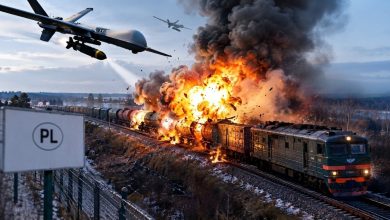
Claims have emerged of a Russian drone attack on a train in Ukraine, around two kilometres from the Polish border. The incident has been portrayed as especially sensitive because several Western figures, including Boris Johnson, Carl Bildt and David Petraeus, were reportedly in the area.
The key point, however, is this: the train that was hit was reportedly not the one on which these current and former officials had travelled. According to the claims put forward, their convoy had left the area a few minutes before the drones arrived, while the train that was struck arrived after theirs.
This distinction is central to understanding the competing interpretations of the incident. Moscow is said to have claimed that it targeted railway infrastructure rather than individuals. Meanwhile, commentary surrounding the event has raised the possibility that it was intended as an intimidating message to Western visitors. The information available does not establish with certainty the precise intent behind the strike.
A train was targeted, but not the one carrying the figures mentioned
The close timing between the passage of a train carrying Western figures and the attack on another train has prompted questions. The situation has been described as a strike occurring shortly after the departure of the convoy carrying the reported visitors.
The available information does not indicate that the train carrying Boris Johnson, Carl Bildt, David Petraeus, Jonathan Powell or other guests was directly hit. Claiming otherwise would mean conflating two separate convoys.
The question therefore remains open: did the attack target only railway infrastructure in the context of the war, or was it also meant to signal that the movements of Western figures in Ukraine were known? The information cited does not make it possible to settle this question.
Why were Western officials in Ukraine?
The presence of these figures is linked to a meeting of the Yalta European Strategy, described as an annual gathering bringing together political leaders, experts and Western representatives to discuss Ukraine, European security and prospects for negotiations with Russia.
Boris Johnson, the former British prime minister, no longer holds a government position. He is nevertheless described as a public voice supporting Ukraine. His trip is therefore associated with his political commitment to the conflict, without any current official role being claimed.
Carl Bildt is described as a former prime minister and former foreign minister of Sweden. His critical positions towards Vladimir Putin and Russia’s invasion of Ukraine are noted. He has notably called the invasion a strategic defeat for Russia and rejected the idea that Ukraine should be regarded as historically tied to Russia.
David Petraeus, a former CIA director and retired US general, is also cited among the participants. He is presented as a supporter of Ukraine who has made several visits to the country since the start of the war. His military and intelligence experience has drawn attention to his presence in this context.
Jonathan Powell is described as the United Kingdom’s national security adviser. Günter Sautter, meanwhile, is presented as a close foreign policy and security adviser to German Chancellor Friedrich Merz. Their presence illustrates the diplomatic and security dimension of discussions related to the Ukrainian conflict.
The debate over the 2022 negotiations
The episode has also revived an older debate about negotiations held at the beginning of the war. A position attributed to Vladimir Putin maintains that Russia never refused negotiations and that a draft treaty was prepared with Ukraine, with the help of Turkey and President Recep Tayyip Erdoğan.
The document is referred to as a draft treaty on Ukraine’s permanent neutrality and security guarantees. According to this account, it was initialled by the head of the Ukrainian negotiating delegation. This interpretation is used to argue that discussions could have ended the conflict at a very early stage.
In this narrative, Boris Johnson is accused of encouraging Ukraine not to accept Russian demands during a visit to Kyiv in 2022. The claim is that he promised Western support in the form of weapons, ammunition, funding and assistance. This accusation is presented as a political interpretation of events and, by itself, does not establish the reasons why the war continued.
The question of the Istanbul talks and why they were interrupted therefore remains controversial. It pits differing interpretations of responsibility, the security guarantees sought, and the conditions that would have been acceptable to each side against one another.
The Russian interpretation of Western visits
From the perspective attributed to Moscow, visits to Ukraine by Western figures are viewed as hostile interference or provocation. Boris Johnson in particular is portrayed as a longstanding political opponent by Russian authorities, who accuse him of helping to discourage negotiations with Kyiv.
This perception explains why the presence of former leaders, security advisers and figures connected to military matters can attract considerable attention. Even without an active government role, these individuals retain the ability to influence Western public, diplomatic and strategic debate.
Conversely, the Western participants are presented as gathering around Ukraine’s future, security in Europe and possible paths to peace. These two interpretations show the scale of the political divide separating Moscow from many Western figures regarding the origins, conduct and desired outcome of the conflict.
A strike with primarily symbolic consequences
If the train carrying the figures mentioned was not hit, the incident still carries significant symbolic weight. A railway strike near Poland, at roughly the same time as a trip by Western figures, may be seen as a signal in a war in which military and political messages are constantly intertwined.
However, it is necessary to distinguish alleged facts from presumed intentions. The available information indicates an attack on railway infrastructure and the presence, on another train, of Western figures who had left the area shortly beforehand. It does not demonstrate that these individuals were directly targeted.
In a wartime context, such caution is essential. Statements by the actors involved, political narratives and strategic interpretations can give the same event radically different meanings. The fact that the train hit was not the one carrying the visitors mentioned remains the decisive element in assessing this matter.
FAQ
Was Boris Johnson’s train hit?
No, according to the claims put forward. The train that was hit reportedly arrived a few minutes after the one on which Boris Johnson and the other figures mentioned had travelled.
What target does Russia say it struck?
The position attributed to Moscow is that the attack concerned railway infrastructure, not individuals.
Can it be claimed that the attack was an assassination attempt?
No. The available information does not establish that the Western figures were the target of the attack.