Ukraine-Russia: Massive Drone Attack Claimed Against Moscow and Russian Targets

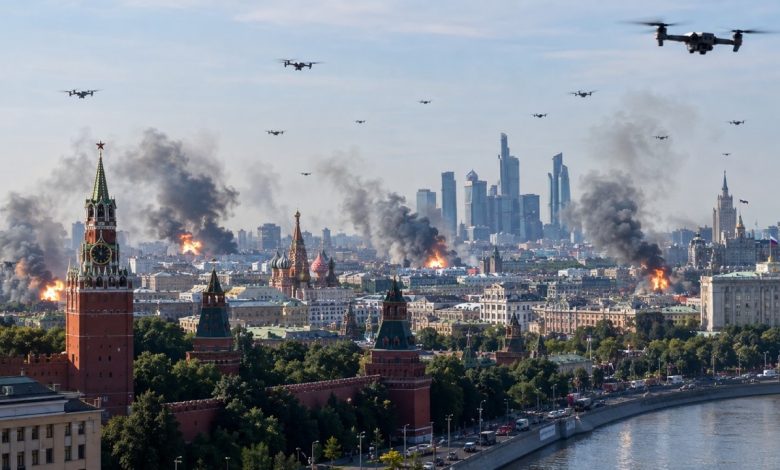
A combined drone and missile attack attributed to Ukraine reportedly targeted Moscow as well as several sites in Russia. The figures cited in the available information are not consistent: they refer to around 1,000 drones, while some reports mention up to 1,600 aircraft launched against Russian territory.
According to Russian authorities cited in these reports, more than 1,100 drones were allegedly shot down. Moscow described the operation as one of the largest drone attacks suffered by the capital since the start of the war. Damage was notably reported at an oil refinery in the Moscow region.
Figures vary across reported information
The most striking aspect of this sequence remains the scale of the figures mentioned. Around 1,000 drones were reportedly directed at Russian targets, including several hundred towards Moscow. Other assessments go further, referring to 1,600 drones in total.
This discrepancy calls for caution when interpreting the toll. The available data do not make it possible to establish with certainty the exact number of aircraft used, their geographical distribution or the precise number of targets hit. However, all the reported versions describe an attack of exceptional scale against Russian territory.
Moscow authorities reportedly said they had neutralised more than 1,100 drones. This announcement highlights both the intensity of the attack and the central role of Russian air defences in the response. The fact that damage was nevertheless reported at an oil facility shows that the claimed interceptions did not prevent all material consequences.
A refinery targeted in the Moscow region
The refinery that was hit is the most clearly mentioned material element in the available toll. According to a position attributed to Ukrainian President Volodymyr Zelensky, oil facilities contribute to financing Russia’s war effort. From this perspective, striking them means targeting infrastructure regarded as economically strategic.
This approach places energy infrastructure at the heart of the conflict. A refinery is not merely an industrial site: it may be viewed as part of the resources needed to sustain military operations. However, the available information does not specify either the exact extent of the damage or the operational consequences of the reported fire.
Targeting Moscow also carries a symbolic dimension. The Russian capital is the country’s political and administrative centre. An attack directed towards this area therefore draws particular attention, regardless of its final material toll.
A timing linked to Russian legislative elections, according to the analysis presented
The timing of the attack was linked to the final days of legislative elections in Russia. The interpretation put forward is that this coincidence may have sought to create a sense of insecurity during the vote and influence Russian public opinion.
This reading, however, is an analysis of intentions attributed to Kyiv rather than an element established by the available information. The political outcome mentioned points in the opposite direction: the United Russia party, aligned with Vladimir Putin, was described as heading for victory despite the attacks. A final turnout of 59% was also mentioned, without further details allowing its context to be verified.
The sequence above all illustrates how military operations, civilian infrastructure and political deadlines can become closely associated in the communication of the parties to the conflict.
Accusations and tensions surrounding European security
Beyond the attack on Moscow, several European states have accused Russia of being involved in security incidents on their territory or near their borders. Germany, Poland, Lithuania and Romania are cited among the countries concerned by allegations related to drones, suspected sabotage, fires, cyberattacks or airspace incursions.
However, the reported elements reveal significant areas of uncertainty. In some cases, incidents are presented as accusations made by national authorities, without the available information making it possible to establish responsibility publicly and definitively. Attributing acts of sabotage, drone incursions or cyberattacks remains a particularly sensitive issue in the context of the war.
European countries are reportedly strengthening their air-defence and counter-drone arrangements. France is also said to have called for stronger protection of critical infrastructure. In Germany, preparations involving hospitals in particular have been mentioned. These measures reflect growing concern over the risk that tensions related to the war could spread or spill over.
Opposing statements by European and Russian officials
The Polish foreign minister, cited in the available information, said that Europe would have considerable air superiority over Russia in the event of an open war. This statement drew a response attributed to Russian Foreign Minister Sergei Lavrov, who said it would be wrong to infer from the fighting in Ukraine Russia’s ability to confront Europe.
Lavrov argued that a confrontation with European countries would be of a different and faster nature. This position forms part of a deterrence rhetoric, as Russia is described as possessing thousands of nuclear warheads.
For his part, Vladimir Putin said that Russia had no aggressive intentions towards Europe and Europeans. He stated that Moscow was prepared to cooperate and restore its relations with its European neighbours. These statements coexist with a climate of deep mistrust and heightened security preparations in several European countries.
NATO, Ukraine and the justifications put forward by Moscow
Current tensions are also linked to the history of NATO enlargement. It is recalled that in 1990, during discussions related to German reunification, US Secretary of State James Baker reportedly gave Soviet leaders a verbal assurance that NATO’s jurisdiction would not expand eastwards.
Poland, Hungary and the Czech Republic subsequently joined NATO in 1999. In 2004, Bulgaria, Estonia, Latvia, Lithuania, Romania, Slovakia and Slovenia became members of the Alliance. In 2008, NATO stated that Ukraine and Georgia would one day become members.
According to the justification attributed to Moscow, this dynamic contributed to the causes of the war. Russia also argued, regarding the annexation of Crimea in 2014, that it was protecting the Russian-speaking population, safeguarding the Black Sea Fleet in Sevastopol and opposing Ukraine’s closer ties with NATO.
These arguments correspond to the reported Russian position. They remain at the centre of a major disagreement over the origins, responsibilities and objectives of the war.
FAQ
How many drones were reportedly used in the attack?
The reported figures differ. Some information mentions around 1,000 drones, while other accounts refer to 1,600 aircraft launched at targets in Russia.
What target was damaged near Moscow?
Damage was reported at an oil refinery in the Moscow region, where a fire was reported.
What response did Moscow announce?
Russian authorities reportedly said they had shot down more than 1,100 drones. Russian officials also reiterated that Moscow said it had no aggressive intentions towards Europe.