Train Targeted Near Poland: What Is Known About Claims of Western Officials’ Presence in Ukraine

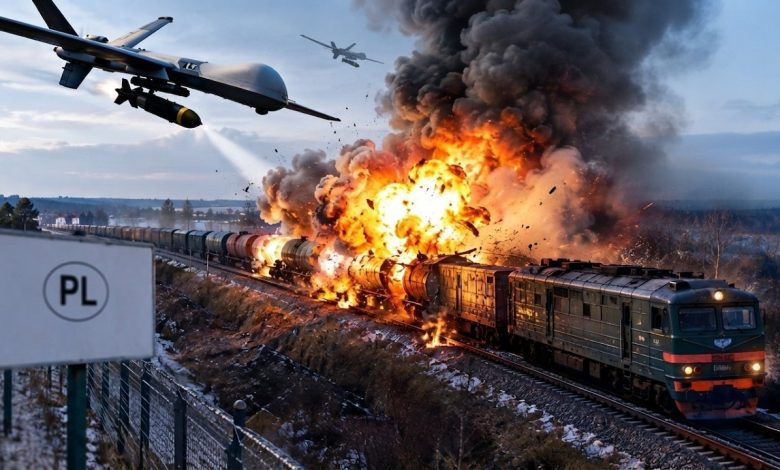
A train was targeted by drones in Ukraine, around two kilometres from the Polish border, according to the reported information. The incident drew particular attention because several Western figures who had attended a meeting on Ukraine and European security were in the area.
However, the central point is this: the train that was hit was reportedly not the one carrying Boris Johnson, the former British prime minister; Carl Bildt, the former Swedish prime minister and foreign minister; David Petraeus, the former CIA director and retired US general; and other participants. Their train had reportedly left the area a few minutes before the drones arrived.
Russia officially says it targeted railway infrastructure rather than individuals. The exact circumstances of the attack, its precise target and any possible connection with the passage of these officials have not been established by the available information.
A train was hit, but not the one carrying the Western figures
The reported sequence is based on the close timing of two rail movements: a first train, reportedly carrying several Western officials and former officials, followed by a second train that was struck by drones shortly afterwards.
This timeline raises questions about the scope of the raid. The fact that the train carrying the figures left the area before the attack does not, by itself, make it possible to conclude that they were directly targeted. Conversely, it also does not rule out interpretations that the operation may have been perceived as a warning or a political signal.
No evidence presented in the reported information makes it possible to state that Russia was seeking to kill Boris Johnson or the other passengers on the first train. This is therefore a possibility that has been raised, not an established fact.
Who were the participants present in Ukraine?
The names mentioned include Boris Johnson, Carl Bildt, David Petraeus, Jonathan Powell and Günter Sauter. They were associated with an annual meeting bringing together political leaders, experts and Western figures to discuss Ukraine, European security and possible negotiations with Russia.
Boris Johnson
Boris Johnson is no longer the Prime Minister of the United Kingdom. Nevertheless, he is described as a public figure committed to supporting Ukraine. His role in debates surrounding the war continues to be regularly discussed, particularly in connection with the Russian-Ukrainian talks held in Turkey at the beginning of the conflict.
According to the reported Russian position, Boris Johnson encouraged Ukraine not to accept an agreement with Moscow in 2022. This interpretation is at the heart of the accusations made against him by Russia. The available information here does not make it possible to independently establish the exchanges that took place between Boris Johnson and the Ukrainian authorities during that period.
Carl Bildt
Carl Bildt is identified as a former Swedish prime minister and foreign minister. He has publicly criticised Vladimir Putin and the invasion of Ukraine. In particular, he has described the war as a strategic defeat for Russia and rejected the historical arguments advanced by Moscow regarding ties between Russia and Ukraine.
His presence at the meeting therefore formed part of a context of Western political support for Ukraine and debates over security conditions in Europe.
David Petraeus
David Petraeus, the former CIA director and retired US general, was also mentioned among the participants. He is described as a supporter of Ukraine, contributing analyses of the conflict and drawing on his military experience. According to the reported information, this would have been his eleventh visit to Ukraine since the start of the war.
David Petraeus also works for the investment firm KKR. The claim that his private activities are directly linked to arms sales or the reconstruction of destroyed countries is mentioned in the material provided, but no precise details are given to establish a connection with this trip or with the railway attack.
Jonathan Powell and Günter Sauter
Jonathan Powell is described as the United Kingdom’s national security adviser. Günter Sauter, meanwhile, is described as a close foreign and security policy adviser to German Chancellor Friedrich Merz.
The presence of these figures illustrates the political and security-related nature of the meeting held in Ukraine. It also explains why the railway incident took on a diplomatic dimension, despite the lack of evidence that their train was the target of the raid.
Moscow’s position on Western visits
Russia portrays visits to Ukraine by Western officials as a form of hostile interference and provocation. Under this interpretation, the participation of former leaders, advisers and former intelligence or military officials is not seen as a neutral undertaking.
Moscow particularly emphasises its opposition to Boris Johnson, who is described as a long-standing adversary. Russia accuses him of having helped to push back the prospect of a negotiated agreement in 2022, when talks were held in Turkey with the support of President Recep Tayyip Erdoğan.
Vladimir Putin has stated that Russia never refused negotiations and that a draft treaty was prepared during the talks. It reportedly concerned Ukraine’s permanent neutrality and security guarantees. According to statements attributed to the Russian president, it was initialled by the head of the Ukrainian delegation.
These claims reflect Moscow’s position on the failure of the initial negotiations. They are not sufficient, on their own, to determine responsibility for the breakdown of the talks or the intentions of all the parties involved.
An incident with political implications, but persistent uncertainties
The raid on the train occurred in a context in which Ukraine’s transport infrastructure is a military issue. Russia says it attacked railway infrastructure, while the simultaneous presence of Western figures has fuelled numerous interpretations.
The most solid point in the reported information is that the train that was hit was different from the one used by Boris Johnson and the other participants. The gap of a few minutes between the two trains is presented as an important fact, without providing evidence of the attackers’ intent.
It is therefore not possible to conclude that the strike directly targeted European and American leaders or former leaders. The incident nevertheless illustrates the risks associated with official and political travel in Ukraine, in a war where civilian and logistical infrastructure remains exposed to strikes.
FAQ
Was Boris Johnson’s train hit?
No, according to the reported information. The train that was hit was reportedly another service, arriving a few minutes after the one carrying Boris Johnson and other participants.
Who does Russia say it targeted?
Russia says it attacked railway infrastructure, not individuals.
Can it be stated that the attack was intended to intimidate Western officials?
No. This possibility has been raised as an interpretation, but no evidence presented establishes that Western officials were the direct target of the attack.