South Africa: Tensions Around Congolese Refugees and Reported Violent Incident

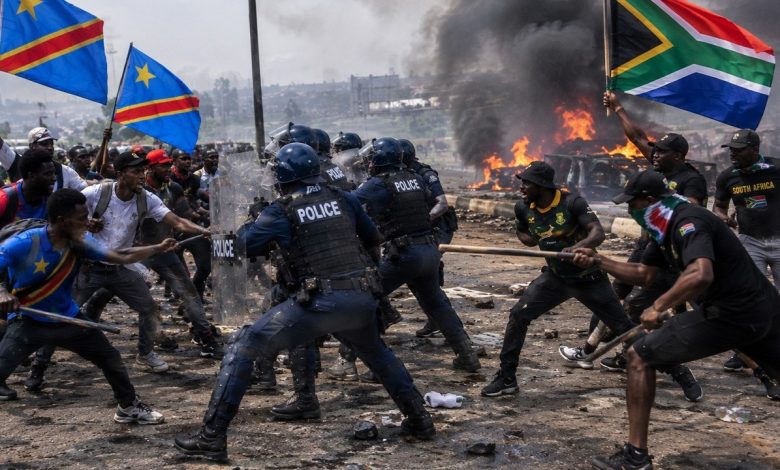
The situation of Congolese refugees in South Africa reportedly led to further clashes amid xenophobic tensions targeting foreign nationals. According to the reported accounts, Congolese people who no longer felt safe in their neighbourhoods chose to gather under tents near a police station. A confrontation reportedly then broke out with South Africans who came to the road where they had settled.
The exact circumstances, precise location and final toll of this incident have not been established by the available information. The accounts nevertheless refer to a police intervention and several injuries among the South Africans involved.
Foreign nationals forced to leave their homes
The context described is one of deep concern among Black foreign nationals living in South Africa, particularly Congolese people. Initiatives aimed at driving foreign nationals out reportedly took place in some neighbourhoods, including visits to homes and reports that made it possible to identify residences occupied by non-South Africans.
People were reportedly forced to leave their homes. The presence of police is described as having reduced the risk of more serious violence, without preventing the reported evictions or pressure. For the families affected, remaining in an isolated home could therefore have been seen as dangerous.
In response to this insecurity, Congolese people reportedly decided to stay close to law enforcement. Their aim was to remain visible, together and in the immediate vicinity of a police station in order to reduce the risk of assault. Tents were reportedly set up on or near a public road.
Road cleaning as the trigger for the clashes
The incident reportedly began when South Africans arrived with cleaning equipment on the road occupied by the Congolese group. In the reported account, those staying there interpreted this action as an attempt to make them leave rather than as a simple maintenance operation.
Police reportedly asked the people who had come to clean the area to move away and not provoke those in the encampment. However, they reportedly insisted on remaining or moving through the area. Tensions then allegedly rose quickly between the two groups.
A man carrying a stick, described in the accounts as a sjambok, reportedly took part in the confrontation. Blows were allegedly exchanged. The Congolese people present reportedly reacted as a group, in what was described as an effort to defend their relatives and their temporary place of refuge.
Two different figures have circulated regarding the number of injured South Africans: one account refers to 13 people injured, while another mentions 11. This discrepancy makes it impossible to confirm a precise number. However, people were reported to have been injured during the confrontation.
The role of the police at the centre of criticism
Police reportedly tried to separate the groups and contain the confrontation. Their actions were nevertheless criticised by some people on the South African side, who believed that law enforcement was protecting foreign nationals rather than the residents who had come to the area.
This criticism is based on conflicting interpretations of the events. For the Congolese people gathered near the police station, the issue was obtaining protection from threats and feared evictions. For those demanding that foreign nationals leave, the presence of tents and families on a public road was seen as unacceptable.
An allegation that a Congolese man had been armed with a rifle was also made after the altercation. However, none of the information presented makes it possible to establish whether this allegation was true, whether a weapon was found, or whether official checks were carried out. It should therefore be regarded as an unconfirmed claim.
Uneven repatriation efforts depending on nationality
The crisis described reportedly did not affect Congolese people alone. Several foreign communities reportedly sought to leave South Africa or requested help from their diplomatic representatives.
Nigerian nationals reportedly went to their embassy in anticipation of repatriation. Flights were reportedly arranged, but some people allegedly remained there while awaiting departures that did not take place. A lack of financial resources to provide all the flights is mentioned in the available accounts, although there are no details allowing the scale of the problem to be confirmed.
Malawians reportedly chose to return by road, particularly by bus. Ghana is also described as having organised several charter flights for the return of its nationals. These situations highlight possible differences in countries’ ability to respond when an expatriate community faces a collective risk.
For Congolese people, returning home is described as particularly difficult because of the security situation in the Democratic Republic of the Congo. According to the reported information, a plane was sent, but no data makes it possible to determine how many people were actually assisted or whether this support continued.
The vulnerability of refugees to xenophobic violence
Above all, this case illustrates the vulnerability of people who have already left their country because of insecurity or serious hardship. When they find themselves under threat in their host country, their options are limited: remain in their homes, move closer to the police, seek help from an embassy, or try to leave again.
Gathering near a police station may appear to be an immediate survival measure. It does not resolve the precarious situation of the families concerned, but it may provide a deterrent presence and more direct access to the authorities in the event of threats.
Clashes are not a solution to the crisis. On the contrary, they demonstrate the level of tension reached when vulnerable populations no longer have a place where they can live safely. Protecting foreign nationals, preventing violence and ensuring a clear response from the authorities remain essential to prevent local incidents from escalating.
FAQ
Why did Congolese people reportedly settle near police in South Africa?
According to the available accounts, they feared remaining in their neighbourhoods after pressure and evictions targeting foreign nationals. Gathering near the police was intended to offer them greater protection.
What reportedly triggered the confrontation?
South Africans reportedly came to clean the road where the Congolese people were staying. This action was perceived as an attempt to drive them away, and the confrontation then reportedly escalated despite police intervention.
How many people were injured?
The toll is unclear. Accounts refer to either 11 or 13 injured South Africans. No final figure can be confirmed based on the available information.