Did Iran Offer $30,000 for the Capture or Death of a U.S. Service Member?

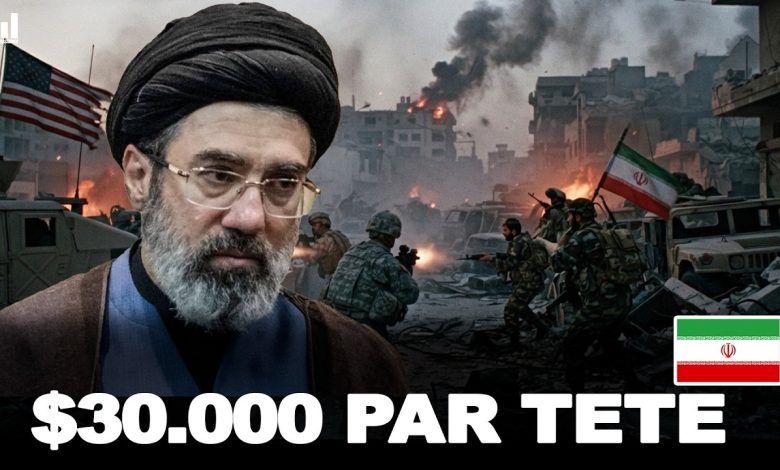
A statement attributed to Amir Atami, described as Iran’s chief of staff, claims that a reward of 5 billion tomans, or around $30,000, would be granted to anyone who captured a U.S. service member or killed one before handing them over to the Iranian authorities. The announced amount would rise to $60,000 if the act were carried out by an Iranian woman.
This announcement, made in a context described as one of open confrontation between Iran, the United States and Israel, carries a military, political and symbolic message. According to the interpretation put forward in the reported remarks, it is intended to mobilise the Iranian population and deter any U.S. infiltration into the country or areas Tehran considers strategic.
What exactly does the announcement attributed to the Iranian authorities say?
The reference amount cited is 5 billion tomans, presented as the equivalent of $30,000. This sum would be intended for anyone who captured or killed an “invading American” and handed them over to the Iranian authorities.
The statement therefore would not distinguish, in its base reward, between the capture and death of a U.S. service member. However, the idea of capture is also presented as a means of responding to concerns over infiltration operations. Under this interpretation, the announcement is intended to signal that civilians as well as military personnel would be encouraged to report or neutralise any U.S. presence considered hostile.
The sum would be doubled when an Iranian woman carries out the same act. The $60,000 amount assigned to women is one of the most striking elements of the statement. It is presented as a way of explicitly involving women in national mobilisation and responding to criticism over the place of women in Iran.
A reward presented as a tool for popular mobilisation
Beyond its amount, the announcement is described as a call for mobilisation not limited to the armed forces. It would address Iranian citizens, men and women alike, based on the idea that defending the country would also be the responsibility of the civilian population.
The reported remarks stress a twofold motivation. The first is financial: $30,000, and more for the women concerned, is the explicitly announced reward. The second is moral and political: the measure is linked to the defence of Iran, the denunciation of possible spies, and the stated desire to resist external pressure.
From this perspective, the aim is not only to offer a sum of money. It is also to make clear that any U.S. presence perceived as infiltration could be reported by citizens. The reward thus functions as a signal of collective vigilance, according to the interpretation given to the announcement.
The context cited: tensions around the Strait of Hormuz
The announcement is linked to the situation in the Strait of Hormuz, described as a strategic maritime passage through which around 20% of the world’s oil is said to transit. Iran is located north of the strait, while Oman lies to the south.
According to the reported claims, the maritime passage has been largely blocked or severely disrupted since the start of the war mentioned between the United States, Israel and Iran. Oman has reportedly also entered into discussions with Iran to find an arrangement over the management of maritime traffic.
Iranian authorities reportedly said that their positions were moving closer to Oman’s and that a final agreement could be considered. This prospect is described as sensitive for Washington, which, according to the reported remarks, seeks to retain decisive influence over the future of the strait.
The Strait of Hormuz therefore appears as a central point in this sequence: it is not merely a maritime area, but a route connected to global oil trade, regional balances and the power relations between the countries concerned.
The threats attributed to Donald Trump against Oman
In the same context, Donald Trump is described as having threatened to bomb Oman if the country obstructed the reopening of the Strait of Hormuz or acted against U.S. interests. These remarks are reported as the second threat of this kind attributed to Donald Trump against Oman.
A previous statement is dated to May 2026 and concerned possible transit fees in the strait. The reported remarks then describe the possibility of striking Oman if the country did not “behave well.”
Oman is nevertheless presented as a traditional U.S. ally. This situation is interpreted as illustrating diplomacy based on strategic interests: under this reading, a partner can face pressure once its choices no longer align with Washington’s objectives.
The same reasoning is extended to South Korea and Spain. South Korea reportedly refused to take part in a war against Iran, while Spain reportedly refused the use of its airspace for U.S. operations against Iran. These refusals are presented as having angered Donald Trump.
The Iranian position: a demonstration of resistance
From the Iranian perspective as presented, the United States would have underestimated Iran’s capabilities. Iranian authorities reportedly claimed to have pushed U.S. forces out of the Persian Gulf region, the Gulf of Oman and the Strait of Hormuz.
These claims are associated with the idea of a “strategic defeat” inflicted on the U.S. military. They reflect the position attributed to Iran in the reported remarks and convey a desire to portray Iranian resistance as effective against a better-equipped military power.
The $30,000 reward, and the $60,000 reward for women, forms part of this messaging of resistance. It combines a financial incentive with a discourse of national mobilisation in which civilians are called upon to participate in defending the country alongside military forces.
FAQ
What amount is announced for the capture or death of a U.S. service member?
The statement attributed to the Iranian authorities mentions 5 billion tomans, presented as around $30,000, for the capture or death of a U.S. service member handed over to the Iranian authorities.
Why would the announced amount be higher for an Iranian woman?
The amount would be doubled to $60,000 when an Iranian woman carries out the same act. This difference is presented as a message aimed at mobilising women and as a response to criticism concerning their place in Iran.
What role does the Strait of Hormuz play in this situation?
The Strait of Hormuz is presented as a strategic passage for global oil. Tensions surrounding maritime traffic through it, as well as discussions between Iran and Oman, form the geopolitical context associated with the announcement.