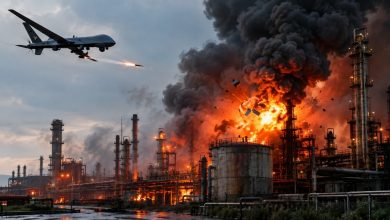
Iran Claims to Have Destroyed a US THAAD System and Intercepted Tomahawks

Iran claims to have destroyed a US THAAD system, described as an advanced missile-defence capability. According to officials from the Islamic Revolutionary Guard Corps, the operation was allegedly carried out using ballistic missiles and precision weapons.
This statement comes amid a confrontation marked by reciprocal threats, accusations over strikes on Iranian territory and the issue of oil exports in the region. The claims made by Iranian officials are presented as such and are not accompanied here by independent evidence confirming them.
Tehran Claims the Destruction of a THAAD System
The THAAD system, or Terminal High Altitude Area Defense, is a US system designed to intercept ballistic missiles. Iranian officials maintain that Iranian forces struck and destroyed batteries of this system.
For Tehran, this claim is intended to demonstrate that even the most sophisticated missile-defence assets would not be invulnerable. The message conveyed by Iranian authorities is also linked to the promotion of their domestic capabilities in ballistic missiles and precision strikes.
The alleged destruction of such a system would have significant military and symbolic implications. A missile-defence system is designed to protect forces, infrastructure or strategic areas against missile attacks. The ability to neutralise it would therefore, if established, be a major issue in the balance of military capabilities involved.
Iran Also Says It Intercepted Tomahawk Missiles
Iranian forces also claim to have intercepted and destroyed several Tomahawk cruise missiles launched against the Islamic Republic. They attribute this outcome to advanced air-defence systems.
The Tomahawk is central to allegations concerning a bombing that struck a girls’ school in southern Iran and, according to the reported information, killed 175 people. Donald Trump then stated that Iran was responsible for the attack, arguing that Iranian munitions were inaccurate.
This account was challenged by a US participant cited in the reported statements, on the grounds that Tomahawks are an exclusively American capability. The central issue in this controversy is therefore the attribution of the strike: Donald Trump accuses Iran of targeting civilians, while the alleged presence of Tomahawk missiles supports an opposing interpretation of events.
No definitive conclusion is provided regarding the exact origin of the strikes or responsibility for the attack. Nevertheless, this episode illustrates the strategic importance of attributing strikes in a war, where each side seeks to establish its own account of events.
Iranian Threats Against Washington’s Supporters
The Iranian foreign minister, identified as Arachic, stated that any country providing assistance to the United States would become a “legitimate target” for Iran. According to this position, Tehran would not remain inactive in the face of states supporting what it describes as US aggression.
The United Kingdom is directly mentioned in this context. The new British prime minister allegedly authorised the United States to use a military base to carry out bombing operations against Iran. In response, Iran reportedly highlighted British personnel and interests in the Middle East, referring in particular to 300,000 Britons in the region.
These statements reflect the possibility of an expanded conflict: beyond a direct confrontation between Iran and the United States, countries facilitating US military operations could be regarded by Tehran as involved in the confrontation.
Oil, a Central Lever in Iranian Strategy
Iranian authorities have also stated that if Iran were prevented from selling its oil, no other country in the region would be able to continue selling its own. This threat rests on the idea that Tehran would have the means to disrupt regional oil exports in the event of a blockade or sanctions targeting its own sales.
For Iran, limiting its oil exports would amount to an attempt at economic strangulation. The announced response is to assert a retaliatory capability that could affect the entire regional energy environment.
Oil therefore emerges as a tool of pressure as decisive as military capabilities. Under this logic, sanctions, trade restrictions and the security of export routes become inseparable elements of the balance of power.
The Potential Role of B-1 Bombers
Donald Trump reportedly ordered B-1 bombers to depart from the United Kingdom for the Middle East. The B-1 is described as a US strategic bomber capable of carrying up to 34 tonnes of bombs and missiles.
Its highlighted characteristics include high speed, partial stealth and the ability to fly at low altitude to reduce detection by radar. It can carry cruise missiles, guided bombs and munitions designed to strike protected or underground facilities.
A single aircraft could engage numerous targets during one operation. Potential targets cited in the event of an escalation include nuclear sites such as Natanz, Fordo, Isfahan and Arak, as well as ballistic-missile and drone bases, launch or storage sites, air bases, command centres and weapons depots.
B-1s could be used to weaken targets before the possible intervention of other bombers, notably B-52s. This possibility underscores the role of long-range air strikes in military scenarios envisaged against Iran.
Long-Term Military Preparation
Iranian rhetoric stresses longstanding preparation for the possibility of an attack. Under this view, Iran would have structured its defences, positioned its military assets and developed protected facilities, including underground sites, in anticipation of possible strikes against its strategic assets.
Russia is mentioned as a partner that could assist Iran without openly intervening. This caution would be linked to the risk of a direct confrontation with the United States and the consequences it could have for the conflict in Ukraine. The idea put forward is that Moscow might favour discreet assistance in order to avoid a direct escalation with Washington.
Iranian claims concerning THAAD and Tomahawks, threats related to oil, and the mention of B-1s together portray a confrontation in which missile defence, air power, regional bases and energy infrastructure are closely interconnected issues.
FAQ
What does Iran claim regarding the THAAD system?
Officials from the Islamic Revolutionary Guard Corps claim that Iranian forces destroyed a US THAAD system using ballistic missiles and precision weapons.
What does Iran say about Tomahawk missiles?
Iran claims to have intercepted and destroyed several Tomahawk cruise missiles launched against its territory using its air-defence systems.
Why are oil exports being discussed?
Tehran says it could disrupt oil exports across the region if its own oil sales were blocked by sanctions or a blockade.
What role could B-1 bombers play?
They are described as capable of carrying a substantial payload of bombs and missiles, striking multiple targets and taking part in operations against Iranian military or strategic facilities.