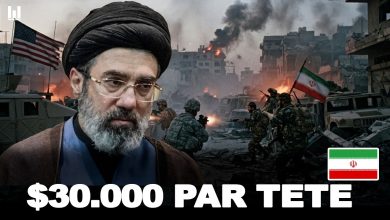
A statement attributed to Amir Hatami, described as the Iranian chief of staff, claims that a reward of $30,000, said in the same account to be equivalent to 5 billion tomans, would be paid to anyone who captured a US service member or handed them over to Iranian authorities after killing them. The announced amount would rise to $60,000 if the act were carried out by an Iranian woman.
This announcement, made in extremely serious terms, is presented as a signal of mobilization in response to a possible US military presence or infiltration. It should nevertheless be treated with caution: the information available here reports a statement attributed to Iranian authorities and a political interpretation of events, without providing independent confirmation of its implementation, legal framework, or the practical conditions for any payment.
What exactly does the announcement attributed to Iranian authorities say?
According to the reported statement, the $30,000 reward would apply to the capture of an “invading American” or to handing such a person over to Iranian authorities after their death. The announcement therefore uses a specific political designation: it targets people portrayed as being connected to US intervention or intrusion.
The same message provides for an amount of $60,000 when an Iranian woman carries out the act in question. This difference in amount is presented as an explicit incentive for women to participate in the defense effort described by Iranian authorities.
The statement is not limited to a financial dimension. It is also presented as a call for popular, military, and civilian mobilization. Under this interpretation, defending the country would not be solely the responsibility of the armed forces, but also of citizens who could report, denounce, or capture people deemed hostile.
A reward framed as part of a deterrence message
The announcement is interpreted as a message intended to discourage any infiltration by US service members or agents into Iranian territory. The possibility of a US ground attack is mentioned as the backdrop to this communication, although no specific evidence provided here establishes that such an attack is real or imminent.
In this logic, the announced reward would serve a deterrent function: to signal that any alleged US presence on the ground could be detected by the population and handed over to the authorities. The sum of $30,000 is thus described as a motivational incentive, alongside references to national honor and spiritual mobilization.
The $60,000 sum offered to women is also presented as a response to Western criticism of women’s status in Iran. This interpretation is a political argument: the difference in reward is used to support the idea that women would participate fully in the country’s defense, according to the authorities or officials cited.
The Strait of Hormuz at the center of the tensions mentioned
The context presented largely refers to the Strait of Hormuz, a maritime passage located between Iran to the north and Oman to the south. It is described as strategic for oil transport, with the account estimating that it carries 20% of the world’s oil. This figure is put forward as an explanation for the area’s geopolitical importance.
According to the reported claims, traffic through the strait has been largely blocked or severely disrupted since the start of a war involving the United States, Israel, and Iran. These claims are part of an account of regional confrontation and are not accompanied, in the available information, by independent details on the actual state of maritime navigation.
Oman is portrayed as seeking to negotiate an agreement with Iran on the management of maritime traffic. Iranian authorities reportedly stated that positions had moved closer and that a final agreement could be considered. Here again, the exact content, timetable, and official status of this potential agreement are not detailed.
Threats attributed to Donald Trump against Oman
The account links these discussions between Oman and Iran to remarks attributed to Donald Trump about the possibility of bombing Oman. This alleged threat would be connected to the Strait of Hormuz and to the United States’ desire to influence its control or the conditions of maritime transit.
It is also claimed that Donald Trump considered designating the strait as American territory. This wording is reported as an element of political pressure in discussions surrounding this strategic maritime route.
The facts presented describe Oman as a traditional US ally, while also maintaining that its efforts to negotiate with Iran would be viewed as contrary to US interests. This interpretation emphasizes an opposition between direct regional negotiations and Washington’s alleged desire to impose its own conditions.
South Korea and Spain: other examples cited
In the same account, Donald Trump reportedly requested South Korea’s support in the Iran issue. South Korea allegedly refused, stating that it did not want to become anyone’s enemy. A possible threat to withdraw US soldiers stationed on its territory is also mentioned.
Spain is also cited. Its prime minister reportedly refused the use of Spanish airspace for US operations against Iran, based on a position summarized as refusing to take part in a war considered contrary to the country’s values and interests. US trade retaliation is then mentioned in the reported remarks.
These examples are used to support one argument: relations between states would not rest solely on alliances, but also on strategic interests and power dynamics. This is nevertheless a political reading based on the available statements and interpretations.
The Iranian position: a claimed victory and popular mobilization
The Iranian officials cited in this account maintain that the United States and Israel underestimated Iran’s military capabilities. Iran claims to have pushed US forces out of the Persian Gulf region, the Gulf of Oman, and the Strait of Hormuz, and to have inflicted a strategic defeat on the US military.
These statements constitute an Iranian claim. The information provided does not make it possible to verify the military results or to precisely assess the US presence in the areas mentioned.
Beyond the military dimension, the message emphasizes “popular resistance.” The $30,000 reward, along with the $60,000 amount announced for women, is presented as a means of extending mobilization to the whole of society. Iranian authorities are thus seeking, according to this presentation, to assert that the country would be ready to respond to any action perceived as hostile.
FAQ
Has Iran officially promised $30,000 for an American?
The available information reports a statement attributed to Amir Hatami mentioning $30,000 for capturing a US service member or handing them over to Iranian authorities after their death. It does not provide independent confirmation that this measure has actually been implemented.
Why is the Strait of Hormuz mentioned in this matter?
The Strait of Hormuz is described as a major maritime route for oil. Tensions between Iran, Oman, and the United States over maritime transit are presented as the geopolitical context for the announcement.
Why is a higher amount mentioned for Iranian women?
The $60,000 amount is presented as a particular incentive for women to participate in the defense effort and as a political argument concerning their place in Iranian society.