Ibrahim Traoré announces tougher measures against extremist preaching in Burkina Faso

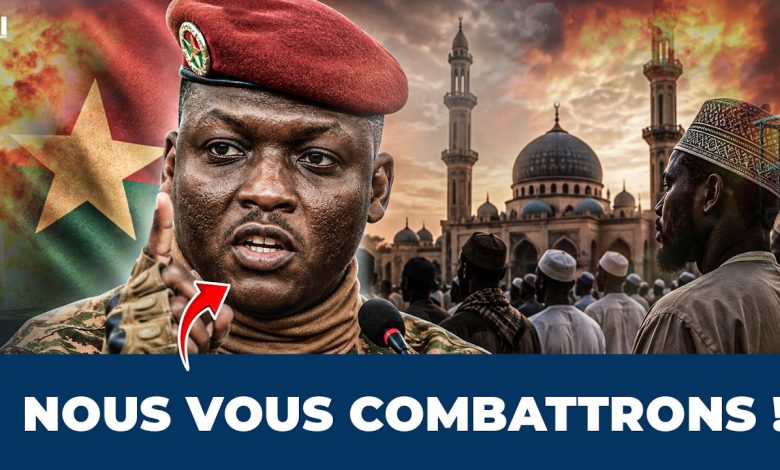
Ibrahim Traoré announced a firm stance against religious discourse he describes as extremist in Burkina Faso. In this speech, he stated that the authorities had already suspended certain sermons and would continue to do so if speakers made remarks that, in his view, promote extremism.
The Burkinabè head of state distinguishes such discourse from the messages conveyed by religious leaders he describes as “worthy,” “dignified” and patriotic. He praised them for their awareness-raising efforts, while calling on other religious actors to distance themselves from radical positions.
A warning against extremist discourse
At the heart of his address, Ibrahim Traoré criticizes an interpretation of Islam that he associates with intolerance, exclusion and violence. In particular, he rejects the idea that someone could be targeted or killed because of their beliefs or identity.
He calls on those who defend such positions to “come to their senses.” Otherwise, he says, the fight against extremism will continue. His remarks do not target all Muslims: on the contrary, he praised imams who, he said, preach a message of peace and help raise awareness.
The Burkinabè leader stated that suspending sermons is a tool already used by the authorities. He warned that this measure could be extended if further remarks deemed problematic are made. The transcript specifies neither the number of sermons concerned, nor the legal criteria for these suspensions, nor the individuals targeted.
Concerns raised over religious training abroad
Ibrahim Traoré also referred to young Burkinabè people in certain Arab countries. He said that a census was under way and indicated that he had seen statistics showing more than 800 people, followed by more than a thousand young people concerned.
According to his statements, some Burkinabè embassies in the countries concerned may not be aware of these young people’s presence, departures or activities. He maintains that those counted would be studying sharia, Islamic law and Islamic jurisprudence, without learning a trade. These elements are presented by Ibrahim Traoré and are not supported by documents in the transcript.
The head of state said he feared that this training could lead some participants to seek to apply sharia in Burkina Faso. He announced his intention to bring these young people back and stated that those who did not return would no longer be considered Burkinabè. The speech does not detail the practical arrangements, legal framework or timetable for such a measure.
Towards national funding for religious training
To address what he presents as a vulnerability linked to external funding, Ibrahim Traoré put forward the idea of public support for religious training. He believes that money plays a role in the appeal of certain institutions or training paths abroad.
He stated that the state would seek a funding formula for different religious communities and traditions: young Catholics, Protestants, traditionalists and other believers. His stated objective is to reduce dependence on funding from outside the country and enable local training.
In his address, he also challenged Burkinabè imams on their ability to train young people within the country. This direction is presented as a response to the risk of indoctrination that he associates with stays of several years abroad. No operational mechanism, budget or deadline was specified in the transcribed segment.
A speech rooted in a broader vision of sovereignty
Beyond the religious issue, Ibrahim Traoré links extremism to what he calls “imperialism.” He says this phenomenon can take different forms and calls on Burkinabè people, as well as Africans more broadly, to identify and combat it.
He places this reflection within a discourse on national cohesion and the protection of populations. He states that he is concerned about the situation of children in the most remote areas of Burkina Faso, particularly their sleep and access to food. These remarks reflect the personal position he expressed during his address.
The president then calls for local production and technological thinking. He mentions cotton processing, the use of clay, iron, steel and oil, as well as the need to create universities and develop technologies. He regrets what he describes as dependence on imported products and calls for more manufacturing and processing on the continent.
This part of his speech extends his main message: for Ibrahim Traoré, the fight against extremism also requires intellectual, economic and educational autonomy. However, the transcript contains no detailed measures concerning the industrial, university or energy projects he mentions.
Key takeaways
Ibrahim Traoré announced the continuation of a firm policy towards preaching that the authorities deem extremist. He says he supports imams whose messages call for peace, while stating that radicalized speakers will be fought and, where applicable, prevented from preaching.
He also mentioned a census of young Burkinabè undergoing religious training in certain Arab countries, announced his intention to bring them back and proposed national funding for religious training. The figures, observations about training paths and stated intentions are those he presented in this address; the segment provides no additional information to verify them or clarify how they would be implemented.
Frequently asked questions
What does Ibrahim Traoré announce regarding extremist preaching?
He states that suspensions of sermons already under way will continue whenever the authorities consider that the discourse amounts to extremism.
What does he say about young Burkinabè people training abroad?
He mentions a census of young people in certain Arab countries and states that many of them would be studying religious subjects there. He says he wants to bring them back to Burkina Faso, without detailing how this would be done.
What religious funding does he envisage?
He announced his intention to find a national funding formula for the training of several religious and traditionalist communities, in order to limit the influence he attributes to external funding.
Video source: watch the video on YouTube.