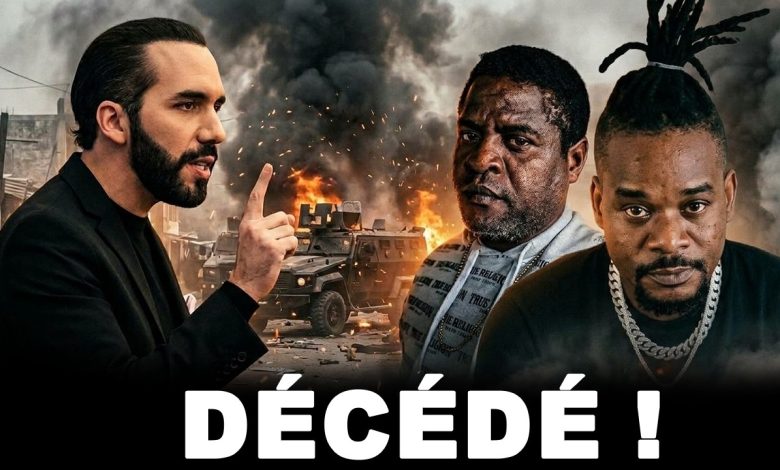
The situation remains uncertain surrounding four Salvadoran personnel who disappeared in Haiti after an ambush attributed to gangs. Several gang members were also reportedly killed during an operation carried out by Salvadoran special forces. Salvadoran authorities say they are continuing their search and dispute the identification of four bodies presented to them.
In this context, Wilson Joseph, described as the leader of the 400 Mawozo gang, said he was ready to cooperate with Salvadoran President Nayib Bukele. He maintains that his group was not responsible for the attack on the Salvadorans and accuses another group, referred to as “Chien Méchant” or “Shan Méchant,” of being involved.
An Ambush Followed by the Disappearance of Four Salvadorans
According to the reported information, the four Salvadorans had gone to a supermarket to shop. As they left, their armored vehicle was reportedly ambushed. Attackers allegedly used automatic weapons and explosives against the vehicle.
One of the men, aged 23 according to available information, was reportedly able to send a video message to his family during the attack. In it, he said that his group was under attack and asked for help.
Several accounts indicate that the occupants left the armored vehicle before disappearing. When forces sent to investigate arrived at the scene, they reportedly found no trace of the four people. The absence of evidence led to the possibility that they had been abducted.
Four bodies were subsequently presented as those of the missing Salvadorans. However, the Salvadoran state rejected that identification after an examination. According to its position, the bodies did not match the people being sought: one was said to be that of a child, while another did not match the recorded body type of the Salvadoran military personnel concerned.
Salvadoran authorities therefore believe that the four people may still be alive and held hostage. They have announced their intention to use every necessary means to find them.
Wilson Joseph Denies 400 Mawozo’s Involvement
Wilson Joseph says he was unaware of the Salvadorans’ presence before they disappeared. He also said that he regretted their deaths, while maintaining, amid conflicting accounts, that they were not dead but were being held.
The leader of 400 Mawozo insists that members of his group were not responsible for the attack. He places responsibility on members of the Chien Méchant gang, with which his group nevertheless reportedly works in certain shared frameworks.
He stated that, had he known the people involved were Salvadorans, he would have sought to negotiate with Nayib Bukele in order to preserve their lives. This statement may be understood as an attempt to distance himself from the attack and prevent Salvadoran operations from targeting his own group.
El Salvador’s position remains opposed to the idea that the four missing people are already dead. Authorities continue to regard them as potential hostages, despite the presentation of four bodies that were rejected as unidentified.
Gangs Grouped Under the Name “Vivre Ensemble”
Haiti is described as being under the influence of several armed groups, including 400 Mawozo, Chien Méchant and the group led by Chérizier. These organizations reportedly decided to form a common front called “Vivre Ensemble.”
This grouping is based on the existence of common adversaries, without erasing the autonomy of each leader and each area of influence. The groups would therefore retain their own responsibilities and structures, even when acting within an alliance.
Statements attributed to certain gang leaders portray their actions as a defense of the Haitian population against economic elites accused of controlling essential sectors. They claim to act on behalf of people facing poverty and fear.
This interpretation is nevertheless challenged by part of the population. Critics point out that these armed group leaders were not elected and that their control has been accompanied by violence. Perceptions of the gangs therefore remain deeply divided: some credit them with a message of rupture, while others condemn their methods and their hold over territories.
Allegations of Violence and a Complex Security Situation
The context is also marked by allegations of serious violence against people associated with gangs. One reported case concerns a young woman known as Baby Love, who was allegedly assaulted after images were shared online showing a person called Nice B and men presented as gang members.
According to the available account, the young woman reportedly sent the images to a cousin, who then published them without her consent. She was allegedly summoned to appear again before being assaulted. Arrest warrants were reportedly issued in the case, but the people targeted had not yet been arrested. However, these elements are reported allegations and do not make it possible to attribute the acts to all armed groups operating in the country.
The disappearance of the four Salvadorans is part of this fragmented security situation, in which the identities of the perpetrators, the responsibilities of the various groups and the fate of the missing people remain subject to conflicting accounts.
An International Presence Mentioned in Haiti
The presence of personnel from several countries in Haiti is described as being linked to an international effort to combat gangs. Kenya is cited among the countries that have deployed personnel. Allegations have also been made against this contingent, but they are not supported here by evidence that would establish them.
According to available information, the United Nations and the United States reportedly considered or supported sending military personnel from different countries to confront armed groups. Nayib Bukele, for his part, reportedly expressed a desire to intensify Salvadoran action and requested authorization to increase the number of soldiers deployed in Haiti.
At this stage, the central issue remains the fate of the four Salvadorans. Between a gang leader’s assertion that they are dead, the presentation of bodies rejected by San Salvador, and the authorities’ belief that they may be hostages, no definitive conclusion can be drawn about their situation.
FAQ
Why are the four Salvadorans being sought?
They disappeared after an ambush against their armored vehicle. Salvadoran authorities believe they may have been abducted and held hostage.
Were the four bodies presented identified as those of the Salvadorans?
No. The Salvadoran state rejected that identification, considering that the characteristics of some of the bodies did not match the people being sought.
What does the leader of 400 Mawozo say?
Wilson Joseph denies his group’s involvement in the attack, identifies another gang as responsible and says he is willing to cooperate with Nayib Bukele.