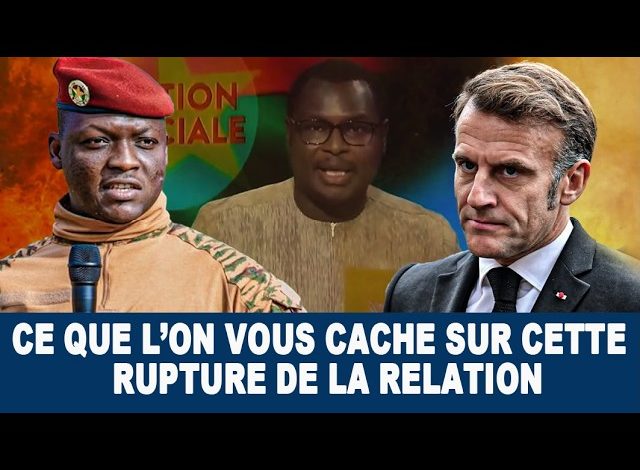
Relations between Burkina Faso and France are at the heart of a debate shaped by sovereignty, security and the role of foreign partners in the country. Several factors have been put forward to explain their deterioration: criticism levelled at the Burkinabè authorities at the European level, disagreements over civil liberties and non-governmental organisations, and Ouagadougou’s closer ties with Russia.
However, it is important to distinguish between reported facts, political positions and competing accusations. The idea of a complete diplomatic break is presented as the end of diplomatic representations and regular government exchanges. Yet the reasons cited form part of a broader context of mistrust between Burkina Faso, France and certain European institutions.
A dispute fuelled by European criticism
On 17 June, Christophe Gomard delivered a highly critical speech in the European Parliament regarding the Burkinabè authorities. His remarks linked the country’s situation to several concerns: the erosion of fundamental freedoms, security challenges and Burkina Faso’s international isolation.
He specifically referred to restrictions affecting associations, media outlets and NGOs. He also highlighted the humanitarian situation and the fact that part of the country’s territory was said to be beyond state control, amid a prolonged fight against armed terrorist groups.
According to this position, worsening security in Burkina Faso could have regional consequences, particularly for neighbouring countries such as Côte d’Ivoire, Ghana, Togo and Benin. The argument put forward is that instability in West Africa is also an issue for Europe.
The European Parliament resolution and the issue of measures
On 18 June, a resolution was adopted by the European Parliament. The reported tally was 476 votes in favour, 75 abstentions and 11 votes against. This development is presented as a major source of tension with Ouagadougou.
Among the options mentioned is the possibility of European measures against Burkina Faso. The European Union is described as having provided the country with around €400 million between 2014 and 2026, notably for roads, hospitals and schools.
This aid is at the centre of a broader political debate. On the one hand, it is presented as support for development and humanitarian action. On the other, it raises questions about dependency: when a state relies on external funding for its infrastructure or public services, that funding can also become a tool of diplomatic pressure.
NGOs, the press and freedoms: opposing interpretations
European criticism focuses in particular on the suspension or dissolution of certain organisations and on restrictions affecting freedom of the press and expression. The question is not only whether measures were taken, but also on what grounds they were taken.
It has been claimed that some NGOs were suspended following investigations because they were suspected of transferring money to terrorist groups. This explanation has been put forward to justify certain decisions, although the detailed findings of these investigations are not presented here.
Restrictions concerning the media and public expression have also been mentioned. Some individuals are said to have challenged the reality or scale of the war against armed groups in Burkina Faso. According to the reported account, people who voiced such criticism were subsequently confronted with the reality on the front line and apologised. Others believe that these apologies were obtained under pressure.
This divergence illustrates one of the main points of friction: the authorities and their supporters stress the security imperative in a country facing terrorism, while their critics underline the risks to civil liberties and civil society.
Closer ties with Russia: a central diplomatic issue
Burkina Faso’s closer relationship with Russia is also among the criticisms voiced at the European level. Some Western officials interpret this direction as a move away from the country’s historical partners.
From the perspective defended by the Burkinabè authorities and their supporters, this diversification of partnerships can instead be understood as a response to a relationship regarded as hostile or insufficiently respectful of national sovereignty. The argument is that a country that feels criticised, marginalised or portrayed negatively will seek new allies.
The disagreement is therefore not limited to the choice of a partner. It also concerns Burkina Faso’s right to define its foreign relations and security priorities without being subjected to political conditionality it considers excessive.
What would a complete diplomatic break mean?
A break in diplomatic relations between two states would have concrete consequences. In principle, it would involve the suspension or sharp reduction of official channels between governments, the absence of ambassadors and limited diplomatic activity in both capitals.
The French embassy in Ouagadougou could then close or operate with reduced capacity. Burkina Faso’s representation in Paris could undergo a similar change. Bilateral meetings, direct exchanges between administrations and traditional forms of governmental cooperation would also be affected.
Such a decision would be a strong political signal: it would indicate that one state no longer considers the other a normal diplomatic partner. It would not, however, by itself summarise all the tensions that have built up over the years.
Security in the Sahel at the centre of accusations
Burkina Faso’s ability to fight terrorism is one of the most sensitive issues. Criticism voiced in the European Parliament points to the worsening security situation after more than ten years of fighting armed groups, including with past support from France and Europe.
Conversely, Mali has accused France of supporting terrorist groups. Malian authorities requested a specific meeting of the Security Council to present what they said was evidence of duplicity, espionage and destabilisation attributed to France, including allegations of intelligence-sharing and equipment drops for the benefit of criminal organisations.
These allegations are serious and contradictory. Above all, they demonstrate the depth of the mistrust that has taken hold in the region. In the absence of evidence tested through an adversarial process in the available information, they do not make it possible to determine which of the accounts advanced by the various actors is correct.
A crisis extending beyond the France-Burkina Faso relationship
Tensions between Burkina Faso and France are part of a wider debate about international influence in West Africa. They bring several approaches into conflict: cooperation subject to conditions relating to human rights and governance, the absolute priority of security, diversification of alliances, and the assertion of sovereignty.
The deterioration in relations therefore cannot be attributed to a single cause. Based on the reported information, it results from European criticism of governance and freedoms, disagreement over the management of terrorism, questions surrounding international aid and a diplomatic shift towards Russia.
Frequently asked questions
Why have relations between Burkina Faso and France become tense?
The tensions are linked to European criticism of civil liberties, NGOs, the press and the security situation, as well as Burkina Faso’s closer ties with Russia and disagreements over national sovereignty.
What does the European Parliament criticise the Burkinabè authorities for?
The reported criticism concerns, in particular, restrictions affecting associations, NGOs and media outlets, the human rights situation, and the effectiveness of the fight against terrorism.
Would a complete diplomatic break have concrete effects?
Yes. It would normally involve the suspension or limitation of diplomatic representations, official exchanges and direct cooperation between the two governments.