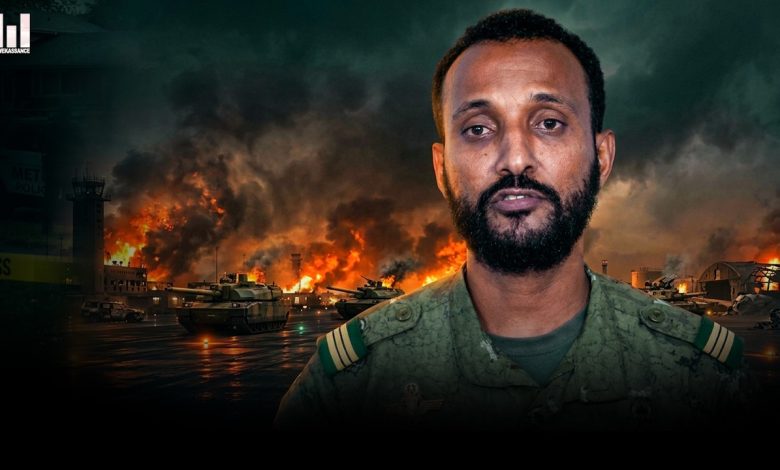
An attempted coup or mutiny involving Nigerien units reportedly targeted Base 101 in Niamey during the night of 28–29 August. Captain Roger Gabriel, an officer in the 1st Parachute Battalion, gave a detailed account of his response to the gunfire, the orders he received and the calls he says he received during those tense hours.
His testimony presents the events as an internal confrontation between a unit operating at Base 101 and the presidential guard. He also says that he informed his superiors of information suggesting, according to his contacts, preparations for an intervention from outside the country. These elements are the captain’s statements and, on their own, do not establish the responsibility of the individuals, institutions or countries mentioned.
Captain Roger Gabriel’s profile
Roger Gabriel describes himself as a captain born on 25 December 1994 in Niamey. He says he serves in the 1st Parachute Battalion as a company commander. He also states that he holds a master’s degree in international relations, is married, has two daughters and lives in Ouallam-Bagagi.
He places his involvement within the events that occurred during the night of 28–29 August. From the outset, he maintains that he did not take part in the operation underway at Base 101.
Awakened by gunfire from Base 101
According to his account, the captain was at home when he was awakened by gunfire coming from Base 101. He says he immediately contacted his battalion commander to report the situation.
He says he was ordered to distribute weapons to members of his unit, secure the Bagagi camp and then await instructions from the chain of command. At that stage, he states, the possibility of a terrorist attack could be considered given the security context.
After the camp had been secured, his unit reportedly received an order from the zone command to secure the second bridge. On returning from that position, personnel reportedly told him that the presidential guard had passed in the direction of the air base.
Exchanges with the presidential guard and command
To understand the situation, Roger Gabriel says he called Captain Mustapha of the presidential guard. Mustapha reportedly told him that he was on a mission in Tounous and gave him the number of Captain Mekibi, who was said to be in Niamey.
Captain Mekibi reportedly explained the situation and gave him instructions on how to proceed. Roger Gabriel says he reported that his men were already holding the second bridge. He then states that Captain Mekibi was with General Hibro, who reportedly asked for confirmation of the parachute battalion’s identity before ordering them to hold the position until national guard personnel arrived.
Later that night, several BSR COS officers reportedly contacted him while strategic positions and the air base were, according to him, being taken. He names Captains Kader, Nasser Neusa and Abdulfatta, as well as Commander Merasi.
The captain explains that his unit had initially reported to its battalion commander that a unit under fire might need support. Command then reportedly confirmed that the situation was a confrontation between the BSR and the presidential guard. Following that confirmation, he says his group rejected requests made to them by the BSR.
Calls referring to outside intervention
The most sensitive aspect of his account concerns several calls and messages he says he received. He states that a Chadian colonel, Hassan Adou, contacted him initially to ask whether a terrorist attack was taking place in Niamey.
Roger Gabriel says he replied that it was not a terrorist attack, but a confrontation between a Nigerien unit and the presidential guard at Base 101. According to him, the caller contacted him again to say that an intervention was being prepared from Chad, with the support of the authorities and French special forces, in favour of the unit deployed at Base 101.
The captain also says he was contacted by members of former president Bazoum’s family, whose names were transcribed as “Zasia” and “Salum”. They reportedly asked him for information on the situation while saying that certain partners were ready to intervene.
According to his testimony, these contacts reportedly mentioned the Beninese president, who was said to have interrupted a trip to Côte d’Ivoire in order to return to Benin and set up a crisis cell. Côte d’Ivoire and French special forces present on its territory were also reportedly mentioned. The captain further reports that his contacts referred to agreements obtained at ECOWAS level.
Numbers associated with several countries
Roger Gabriel says he received other calls or attempted contacts from numbers associated with France, Dubai and Belgium, which he says he did not answer after understanding the nature of the situation. He nevertheless specifies that the apparent origin of a number does not necessarily identify the actual location from which a call is made.
He also mentions WhatsApp messages. A man named Hamid Ngadé reportedly asked him for news of the situation and assured him that French partners were ready to intervene in support of the unit deployed at Base 101. Colonel Saidina, according to the captain, wrote to ask whether any people were still holding a position and required support.
Finally, he says he received a message from the Chief of Staff of the Chadian Air Force announcing an intervention. The captain states that all of these calls, messages and reported events were included in a report to his superiors.
What this account establishes
Roger Gabriel’s testimony describes a night marked by gunfire, the deployment of units around strategic positions in Niamey and a confrontation between Nigerien forces. He presents his own role as that of an officer who secured his camp and the second bridge in accordance with the instructions he received.
He also makes serious allegations regarding the involvement or readiness of outside actors, citing Chad, France, Benin, Côte d’Ivoire, ECOWAS and relatives of former president Bazoum. These claims are reported conditionally: they arise from contacts the captain says he had and information he says he passed on through his chain of command.
FAQ
What role does Roger Gabriel say he played during the events?
He says he did not take part in the operation against Base 101. He states that he had his personnel armed, secured the Bagagi camp and then held the second bridge on the orders of his superiors.
Who does the captain identify as the parties to the confrontation?
According to his account, command confirmed to him that it was a confrontation between the BSR and the presidential guard.
Are the countries mentioned formally established as having been involved?
No. Their mention is based on the calls and messages Roger Gabriel says he received. His testimony reports allegations and does not, on its own, constitute formal proof of involvement.