Ghana Declines 20 Million Cedi Donation Offered After Xenophobic Attacks

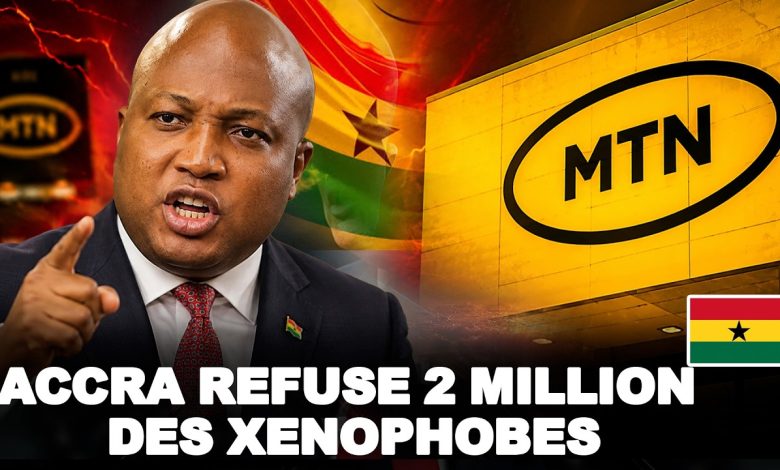
The Ghanaian government declined a 20 million cedi donation, presented as equivalent to around $2 million, intended to support Ghanaian nationals affected by xenophobic attacks in South Africa. The offer was linked to MTN in the reported information.
Authorities in Accra did not portray the decision as a rejection of assistance for those affected. They explained that they had already made the necessary provisions to organise the evacuation of affected Ghanaians and support their reintegration upon return. The decision therefore places the state’s response at the centre of how the situation is being managed.
A donation intended for people affected by xenophobia
The proposed amount was meant for Ghanaians affected by xenophobic violence in South Africa. These incidents targeted African migrants, including Ghanaian nationals.
The sum of 20 million cedis was described as financial assistance worth around $2 million. In the available information, the offer is described variously as coming from MTN South Africa or MTN Ghana. In all cases, it is presented as an initiative linked to the MTN Group and aimed at affected Ghanaians.
The context is particularly sensitive: foreign nationals faced hostility and humiliation, alongside calls for them to leave certain neighbourhoods. For those concerned, the issue is therefore not limited to material assistance. It also concerns safety, repatriation, reception upon return and consular protection.
Why did Ghana decline the offer?
Ghana’s position rests on a specific argument: the state had already put resources in place to evacuate its nationals from South Africa and reintegrate them upon their return. The refusal was described as having been made respectfully.
This explanation gives the decision an institutional dimension. By directly taking responsibility for financing and organising the return of its citizens, the government signals that it wants to retain control of the public response to a crisis involving its nationals abroad.
The debate prompted by this choice concerns several issues: sovereignty, national dignity, the country’s image and political control over aid. Having a state-led repatriation mechanism makes it possible to avoid assistance to victims appearing to depend on a company linked to the country where the attacks took place.
The refusal does not mean that the needs of evacuated people are being ignored. On the contrary, the stated justification is that public arrangements were already in place to support them. The issue, therefore, is the role the state intends to retain in protecting its citizens beyond its borders.
The role attributed to Samuel Okudzeto Ablakwa
Samuel Okudzeto Ablakwa, Ghana’s foreign minister according to the reported information, is associated with this position. His actions are presented as part of an active policy of defending Ghanaian nationals facing difficult situations abroad.
Reference is made in particular to efforts involving Ukraine concerning Ghanaians detained in the context of the Russia-Ukraine war, as well as an intervention in Russia requesting that Ghanaians no longer be recruited. These elements are cited to underline the importance authorities place on assisting and representing citizens outside the country’s territory.
In the South African case, this approach translates into a preference for a repatriation arrangement led by Ghana. The stated objective is to enable the nationals concerned to return to their country through a process organised by their own authorities.
Xenophobia: a phenomenon extending beyond South Africa
The attacks on migrants in South Africa form the immediate context of this matter, but xenophobia has also been raised in connection with other African countries. Tensions involving foreign communities have been mentioned in Senegal, Gabon, Angola and Kenya.
According to the analysis put forward in the available information, periods of intense social pressure can encourage the scapegoating of foreigners. Unemployment, housing difficulties and crime are cited as factors that may fuel tensions, without in any way justifying violence or humiliation.
This situation is a reminder that the response cannot be limited to repatriation. Protecting migrants, preventing violence, enforcing the law against perpetrators and addressing the social causes of tensions are also central issues.
A decision with symbolic and political significance
Ghana’s decision to decline the donation is presented as an act of sovereignty. It underlines that financial assistance, even when intended for victims, can take on political significance when it follows violence against foreign nationals.
For the Ghanaian authorities, the principle being emphasised is one of national responsibility: evacuating the citizens concerned, receiving them upon their return and organising their reintegration using resources already provided by the state.
This matter ultimately raises a broader question for governments: how can external assistance, often necessary in certain crises, be reconciled with the public responsibility to protect citizens and retain control over decisions made in their name? In this case, Ghana chose to prioritise its own mechanism.
FAQ
What amount did Ghana decline?
The amount mentioned was 20 million cedis, or around $2 million according to the reported information.
Who was the assistance intended to benefit?
The donation was intended to support Ghanaian nationals affected by xenophobic attacks in South Africa.
What reason did the Ghanaian government give?
Authorities said they had already allocated sufficient resources to evacuate the Ghanaians concerned and support their reintegration after their return.