Ukraine and Russia: Refinery Strikes at the Heart of Tensions With Donald Trump

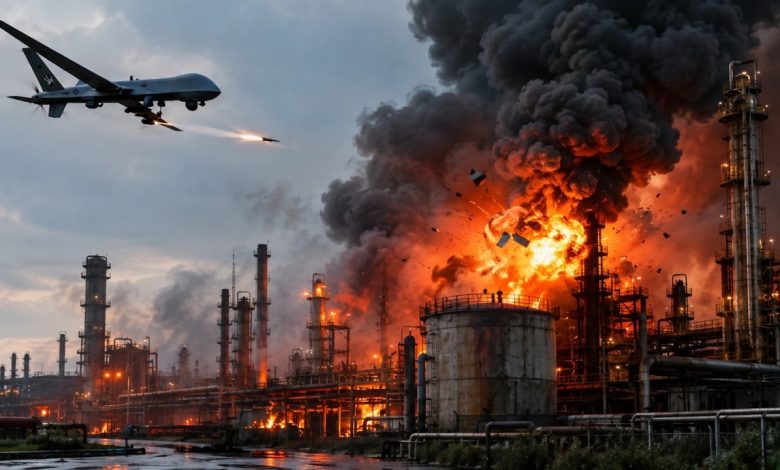
A strike attributed to Ukraine against a refinery in Russia’s Samara region has revived questions about the strategy of targeting Russia’s energy infrastructure. According to the information cited, the attack came as Donald Trump was said to have asked Volodymyr Zelensky not to target Russian energy facilities, as part of a possible truce in this sector.
The reported events raise several questions: was the strike a response to Russian attacks on Ukrainian infrastructure, or did it represent a disagreement with the approach advocated by Donald Trump? The information available in the material presented does not make it possible to decide between these interpretations.
A Samara refinery reportedly targeted
The target mentioned is a refinery in Russia’s Samara region. The attack is described as another Ukrainian strike against Russia’s oil-refining sector. It comes at a time when energy infrastructure is portrayed as a major issue in the conflict between Russia and Ukraine.
Strikes on refineries could, according to the analysis put forward, reduce Russian refining capacity. A decline in this capacity would limit the volumes of diesel and other petroleum products available for export. This could contribute to tightening the global fuel market, particularly for diesel.
The material directly links this energy issue to the situation in the United States. It states that higher diesel costs would affect US consumers, transport and agriculture, while American refiners could see their margins increase. It is also argued that fuel prices are a particularly sensitive issue for US voters.
Donald Trump’s reported request regarding energy infrastructure
Donald Trump was said to have explicitly asked Volodymyr Zelensky not to strike Russian energy infrastructure. This position is linked to the idea of an agreement or truce concerning energy facilities.
The rationale attributed to this request is economic as well as diplomatic: limiting disruptions to Russian refining would, under this interpretation, avoid additional pressure on the international market for petroleum products and on diesel prices in the United States.
Donald Trump also said, according to the reported remarks, that he wanted to end the war in Ukraine. He had argued that a conflict of this scale would not have begun if he had been president instead of Joe Biden. The material indicates that the efforts undertaken to secure a swift end to the war did not succeed.
In this context, continued attacks on Russian refineries are interpreted as a potential obstacle to de-escalation in the energy sector. This remains an interpretation, however: none of the material presented establishes that the Samara strike was intended to personally challenge Donald Trump or undermine his initiatives.
The question of possible Ukrainian retaliation
Another explanation is raised: the Ukrainian strike may have been carried out in retaliation for Russian attacks on Ukraine. The material states that Volodymyr Zelensky accused Russia of striking Ukrainian infrastructure first.
In a war marked by repeated attacks on sites regarded as strategic, the argument of retaliation is regularly advanced by the parties involved. Here, two hypotheses are presented without it being possible to distinguish between them: retaliatory action after Russian strikes, or a decision to maintain pressure on Russian energy capacity despite US requests.
The distinction is politically important. A retaliatory strike would fit into a bilateral military logic between Moscow and Kyiv. A strike conceived in opposition to the US position would have broader diplomatic implications. The material provided does not document any evidence allowing either of these motives to be attributed with certainty to the Ukrainian authorities.
Claims concerning Western figures in Ukraine
The material also mentions the presence in Ukraine of Boris Johnson, an unidentified former CIA official and several European figures. It refers to a Russian strike that reportedly hit a train travelling from Kyiv to Warsaw, with these individuals among the passengers. These claims are presented as contextual elements, without details that would establish the circumstances, date or consequences.
Boris Johnson is portrayed as a figure regularly associated by Moscow with a position favouring continued support for Ukraine. The material contends that he encouraged Volodymyr Zelensky to continue the war, notably by promising weapons as well as financial, moral and material support.
It also refers to talks held in Turkey at the beginning of the war between Russia and Ukraine, with the assistance of the Turkish president, concerning a possible agreement. According to this account, continuing the conflict was subsequently favoured. These elements reflect a political reading of how the negotiations unfolded and are not, on their own, sufficient to establish responsibility for the failure of a possible agreement.
A Russian narrative alleging Western coordination
Russia has long claimed, according to the material presented, that coordination exists among certain Western actors to prolong the conflict and use Ukraine against Donald Trump’s interests. Under this interpretation, strikes on Russian refineries would contribute to rising energy prices, politically weakening the US president.
This theory is presented as a Russian assertion and as political analysis, rather than as an established fact. It is based on the idea that reduced refining in Russia could affect diesel and petroleum products globally, then have repercussions in the United States.
The reasoning highlights a possible sequence: pressure on Russian refining capacity, tighter petroleum-product markets, higher costs for US sectors dependent on diesel, and then a political cost for Donald Trump. However, the link between a specific strike, changes in US prices and a political intention directed against Donald Trump is not demonstrated by the material provided.
An already tense relationship between Trump and Zelensky
Relations between Donald Trump and Volodymyr Zelensky are described as tense, particularly after a public episode at the White House during which Trump was said to have been especially harsh toward the Ukrainian president. This episode is cited to explain speculation over Kyiv’s motives.
Nevertheless, the existence of personal or diplomatic tensions does not make it possible to assert that the attack on the Samara refinery was intended to provoke Donald Trump. The strike may reflect military logic, a response to Russian attacks, a strategy to pressure Russia’s energy economy, or a combination of these factors.
Key takeaways
The strike attributed to Ukraine against a refinery in the Samara region places energy infrastructure at the centre of tensions between Kyiv, Moscow and Washington. It comes as a request attributed to Donald Trump called for Russian energy facilities to be spared.
The potential consequences for Russian diesel exports, the fuel market and US prices are central to the commentary presented. However, Ukraine’s precise intentions, the exact circumstances of the strike and the existence of a strategy aimed at politically harming Donald Trump remain uncertain based on the material provided.
FAQ
Which Russian facility was reportedly struck?
The target mentioned is a refinery in Russia’s Samara region. The material presents it as having been targeted in a strike attributed to Ukraine.
Why are Russian refineries a strategic issue?
Refineries turn crude oil into products such as diesel. A reduction in refining capacity can limit exports of petroleum products and contribute to a tighter fuel market.
Did Donald Trump ask for energy strikes to stop?
According to the information reported, Donald Trump asked Volodymyr Zelensky not to target Russian energy infrastructure, with a view to a truce on this type of target.
Was the strike intended to weaken Donald Trump?
This hypothesis is raised as part of a political analysis, but it is not established by the information presented. Other explanations, including retaliation for Russian attacks, are also mentioned.