Alleged Threat Against Donald Trump in Turkey: The Story of a Secret Evacuation

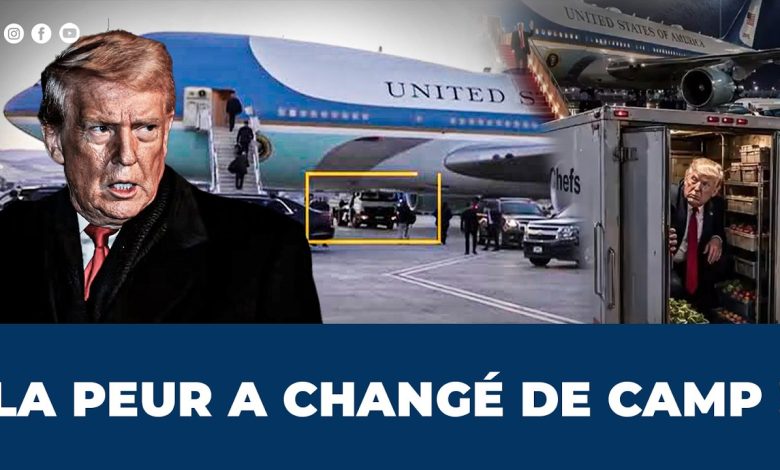
An account said to be connected to a NATO summit in Ankara, Turkey, claims that Donald Trump was the subject of exceptional security measures following threats attributed to Iran. According to this version, the US president was discreetly transferred from a presidential aircraft to a smaller military plane in order to reduce the risk of being targeted during his departure.
These claims describe a diversion operation involving several aircraft, an airline catering truck and measures intended to conceal the president’s actual route. However, the information provided does not make it possible to independently establish the reality of this operation, the alleged threat or the technical details put forward.
The scenario of a discreet airport transfer
The account places the events after a NATO meeting in Ankara in July 2026. The discussions reportedly focused in particular on the Alliance’s collective defence, military budgets, aid to Ukraine and tensions surrounding Iran.
At the time of departure, Donald Trump reportedly publicly boarded a Boeing 747 presented as Air Force One. Cameras allegedly showed him waving and entering the aircraft, creating the impression that he was to leave Turkey on board.
According to the same account, he then discreetly exited through another door, accompanied by a small number of members of his team. He reportedly used an airline catering truck, normally used to deliver meals and supplies to aircraft.
The vehicle reportedly took him to a C-32A, described as a military version of the Boeing 757. That aircraft then allegedly departed with Donald Trump for England, heading to the RAF base mentioned in the account.
Three aircraft at the centre of the claims
The account rests on the use of three separate aircraft. The first was allegedly used for the US president’s arrival in Turkey. It is presented as a Boeing 747-8 donated by Qatar and adapted for presidential functions.
The second aircraft was reportedly the Boeing 747 used in the staged departure. Donald Trump allegedly entered it in front of cameras in order to make it appear that he was travelling aboard that plane.
The third aircraft, the C-32A, was allegedly the means of transport actually used for the departure. According to the reported claims, journalists and part of the team remained on the first aircraft used for the diversion, while the window shades or windows were obscured.
The account also maintains that the flight carrying Donald Trump used discreet call signs in order not to draw attention. It is further claimed that the C-32A was not detected on radar. These details are not supported by verification evidence in the available information.
A threat attributed to Iran
The reason given to justify this operation is the existence of intelligence indicating an Iranian plot targeting Donald Trump. The threat reportedly concerned his air travel and was considered serious enough by US officials to alter the departure protocol.
The risks cited include man-portable air-defence systems, often referred to by the acronym MANPADS, which could target an aircraft from the ground during vulnerable phases such as take-off. The account also mentions ballistic missiles and drones among the military capabilities attributed to Iran.
An unidentified country reportedly provided intelligence to Washington. However, according to the information provided, Turkey questioned the reliability of that intelligence and urged caution in assessing it. The identity of the country, the exact nature of the intelligence and its level of confirmation are not specified.
Lasting tensions between Washington and Tehran
The account places this alleged threat within the broader context of strained relations between the United States and Iran. Several points of conflict are cited: Iran’s nuclear programme, Tehran’s support for armed groups, attacks against US and Israeli interests, and the death of General Qassem Soleimani in 2020.
Donald Trump is portrayed as opposed to Iranian nuclear ambitions and concerned about regional activities attributed to Tehran. Iran, for its part, is described as asserting its right to be respected and to defend its interests.
The account also claims that Donald Trump considered extremely severe retaliation in the event of an attack against him. This statement is reported in the information provided, without a date, specific context or document that would allow it to be authenticated.
Why a ground invasion is presented as unlikely
The available information suggests that a ground operation against Iran would be considered particularly costly and risky. The factors cited include the potential number of casualties, financial cost, the risk of a prolonged war and the difficulties of an occupation.
The risk of regional escalation and the political consequences of such a conflict are also highlighted. Under this interpretation, the United States would instead favour limited options, such as air strikes, missiles, sanctions or other actions that would not require a large-scale ground commitment.
However, this is an analysis put forward in the account provided, rather than an official position documented in the available information.
Presidential diversion as a protective strategy
The method described is based on a simple principle: creating uncertainty about the actual means of transport used by a protected individual. Making it appear that a leader is on one aircraft while transferring them to another could make it more difficult to prepare an attack against their convoy.
The account recalls that US leaders have allegedly previously used diversion measures when travelling through areas considered sensitive. It specifically mentions Bill Clinton, who allegedly used aircraft changes during trips to Pakistan and India. No further verification details are provided regarding this example.
Beyond Donald Trump’s case, this story highlights the importance attributed to intelligence, operational discretion and threat assessment. Even when information is uncertain or disputed, it can lead to enhanced protective measures if authorities deem it sufficiently concerning.
Key takeaways
The account of Donald Trump’s secret departure from Turkey rests on serious claims: a threat attributed to Iran, a diversion aboard a Boeing 747 and a covert transfer to a C-32A. It presents this arrangement as a response to a potential airborne threat.
Nevertheless, the available information provides no independent confirmation of the operation, the alleged attack plot, Iranian involvement or the precise course of the flight. Caution is therefore necessary when considering these claims, particularly as some of the intelligence cited was itself reportedly disputed.
FAQ
Was Donald Trump secretly transferred to a military aircraft in Turkey?
The available account says he was, describing a transfer via an airline catering truck to a C-32A. However, the information provided offers no independent confirmation.
Why is Iran mentioned in this case?
The threat said to have prompted the alleged operation is attributed to Iran. The available information refers to a risk of an attack against the presidential aircraft, without providing independent evidence of such a plot.
What was the alleged role of the C-32A?
The C-32A is presented as the military aircraft that allegedly carried Donald Trump after his discreet transfer. In this account, it would have made it possible to avoid using the presidential aircraft publicly visible at departure.