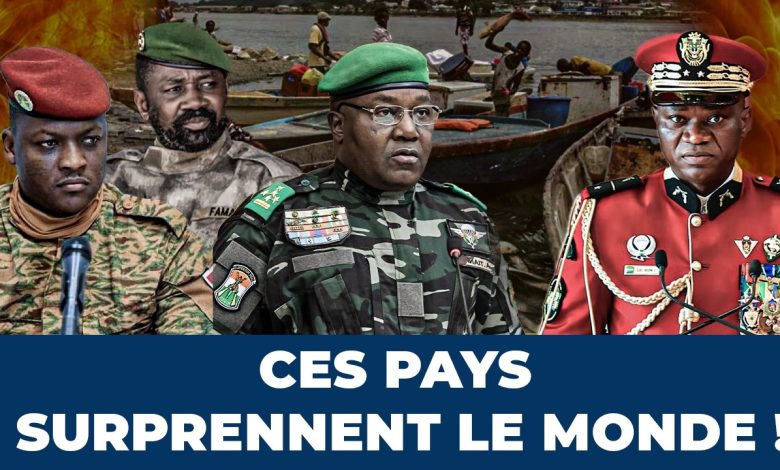
The video claims that the gross domestic product (GDP) of the Alliance of Sahel States (AES), made up of Niger, Burkina Faso and Mali, grew by an average of 5.5%. It attributes this development to a series of decisions made in the three countries: political and security cooperation, greater control over resources, local processing and investment in certain productive sectors.
This presentation is based on the elements cited in the video. Several figures, dates and decisions are mentioned without detailed documents in the transcript. They should therefore be understood as claims reported by its author.
The AES and the pursuit of joint action
The video recalls that Mali, Burkina Faso and Niger signed the Liptako-Gourma Charter in 2023. According to the interpretation presented, this agreement is based in particular on a principle of mutual assistance in the event of an attack against one of the three states.
The author also mentions the deployment of 5,000 soldiers within this framework, without further specifying the status, exact date or operational arrangements of this force.
Beyond security, the video presents the AES as a practical integration project. It notably mentions the introduction of a common biometric passport to facilitate travel between the three countries.
A shared telephone communications system is also cited. The stated objective is to limit roaming costs for people travelling, for example, between Mali and Burkina Faso, and to simplify exchanges within the AES area.
Niger: uranium, gold and working conditions
To explain the economic momentum it describes, the video begins with Niger and its extractive sector. It claims that the Nigerien authorities have regained control over uranium and want to obtain better sales terms.
The author compares a price of $0.80 per kilogram, which he attributes to the former terms under which France purchased Nigerien uranium, with $80 per kilogram for uranium presented as similar and purchased in Canada. He claims that, after General Abdourahamane Tiani came to power, Niger demanded a price of $80 per kilogram. No verification material or contractual details are provided in the transcript.
The video also refers to the cancellation of certain gold mining licences. According to it, the companies concerned were not meeting their tax commitments and the expected revenues were not benefiting the country sufficiently.
In oil and gas, the author mentions new contracts with Chinese companies. He claims that pay disparities existed between Chinese engineers, paid around $10,000 per month, and Nigerien engineers at a comparable level, paid around $1,300. The video attributes to the authorities a desire to rebalance these salaries and promote national employment.
Finally, it reports that a Chinese hotel that allegedly accepted only Chinese customers was banned or closed in Niger. Here again, the transcript provides neither the name of the establishment nor an official source for this decision.
Burkina Faso: gold mines, local processing and agricultural equipment
In Burkina Faso, the video focuses on the buyback of several gold mines, notably those of Boungou and Wahgnion. It contrasts this method with a licence withdrawal: according to the author, a buyback would avoid alarming investors, since the state pays compensation to take over the assets.
The amount of $80 million is put forward for these operations. The video also announces the construction of a gold refinery presented as the first in the country, with a capacity of 150 tonnes per year and completion expected in 2026.
Agricultural processing is another area cited. The author refers to the opening of a tomato processing plant in 2024. His reasoning is that local processing of raw materials could create jobs and related activities in transport, accommodation, services and infrastructure.
The video also claims that $179 million was allocated to the purchase of agricultural machinery, some of which reportedly came from China. It sees this as a lever for developing national production.
On infrastructure, it mentions the construction of 5,000 kilometres of paved roads per year by local companies, as well as hospital-related projects. This preference given to Burkinabè companies is presented as a way to develop their skills and experience.
Mali: a larger state share in mining resources
The video then discusses Mali, where it describes new rules in the gold sector. According to its author, the Malian state is seeking to hold a larger stake in mining companies.
It also mentions a project for Mali’s first gold refinery. The idea advocated is similar to that mentioned for Burkina Faso: to process more locally rather than limit the country’s role to extracting the resource.
According to the video, $33 million in mining revenues was distributed to local communities. These funds were reportedly intended for schools, clinics and farms. The transcript does not specify the period concerned, the recipient communities or the distribution mechanism.
Lithium is also presented as a strategic sector. The video highlights its use in batteries, electric vehicles and solar storage. It claims that Mali has become one of Africa’s leading lithium producers and that the state holds a 35% stake in this sector, without specifying the company or project concerned.
A perspective focused on economic sovereignty
The central theme of the video is the desire to strengthen public and local control over natural resources, mining activities, industry and infrastructure. Its author considers that this approach explains the economic progress he attributes to the AES.
However, the video takes a clear political stance on the leaders of the three countries and on governance models. The data and examples it cites should be distinguished from the comments and judgments expressed in the segment.
FAQ
Which countries make up the AES?
According to the video, the Alliance of Sahel States includes Mali, Burkina Faso and Niger.
What GDP growth is announced in the video?
The video refers to average AES GDP growth of 5.5%, attributed to Ecobank. The transcript does not provide the report, the exact period or the associated methodology.
Which sectors are highlighted?
The video cites uranium, gold, oil and gas in Niger; gold, agriculture and roads in Burkina Faso; and gold and lithium in Mali.
Video source: WHAT NO ONE HAD FORESEEN: OLIGUI CHANGES GABON AND THE AES SURPRISES THE WORLD!