In Senegal, the general policy statement revives debate over the government’s direction

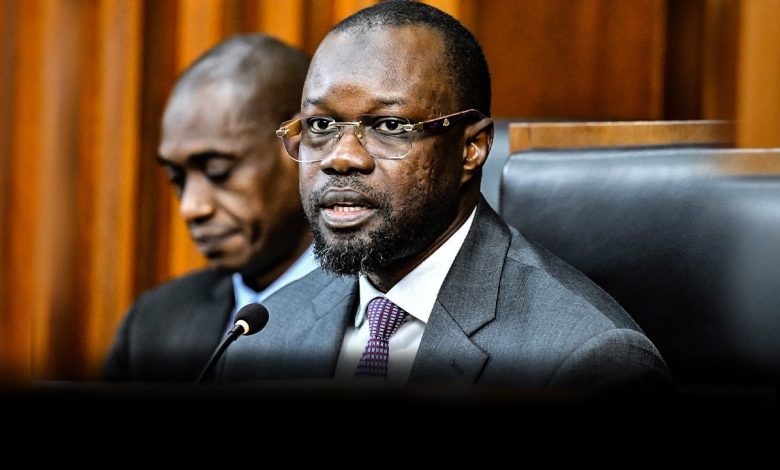
A transcribed segment of a general policy statement before Senegal’s National Assembly highlights a political debate focused on continuity in public action, the Senegal 2050 framework and the economic difficulties raised by a speaker. The reported remarks contrast, on the one hand, the stated intention to stay the course and, on the other, criticism of the perceived rise in the cost of living, employment and the government’s priorities.
The transcript brings together several speeches. On its own, it does not make it possible to establish the full context of the session or verify the accusations and data put forward in the exchanges. The grievances expressed should therefore be understood as the positions of their author.
A case for continuity under Senegal 2050
In the first part of the segment, the speaker says he does not wish to challenge the directions of a vision described as that of a “sovereign, just and prosperous Senegal,” rooted in strong values. He announces that the course will be maintained, while referring to a change in method inspired by his professional background.
His speech is explicitly framed within the national Senegal 2050 systemic transformation framework. According to his statements, this framework forms the foundation of his general policy statement and his “sole direction.” He links this vision to the “Diomaye President” electoral programme, which he says was translated into a framework under the authority of the head of state.
The speaker also reflects on his own career within the administrative apparatus. He says he was approached for a ministerial post while he had been serving for 61 days as Secretary General of the BCEAO. He then states that he served as Minister Secretary General of the Government between April 2024 and April 2025.
He specifies that he coordinated a team tasked with translating the programme into a framework, then took part in overseeing its implementation as a “master plan” at the Prime Minister’s Office. Finally, he states that he oversaw the completion of this master plan and the structuring of the framework’s strategic steering when he was Minister of State to the head of state, in charge of the Senegal 2050 agenda.
Institutions, political transitions and public responsibility
Beyond the programme, the speech stresses the place of institutions. The speaker presents as a positive sign for democracy the presence of a head of government before a person who has become President of the National Assembly. In his view, this image illustrates the fact that institutions take precedence over leaders and that the state continues to function when officials change positions.
He also pays tribute to those who previously led the country or headed its government. While acknowledging that their choices may be debated, he states that the Senegal handed down has remained “standing,” united and free.
His vision of public action rests on an idea of continuity: each generation of leaders receives, in his view, an unfinished work. The responsibility, therefore, would be to consolidate what works, repair what risks giving way and adapt the whole to the challenges of the moment.
In this context, he believes that a critical review of the past can be useful if it makes it possible to identify mistakes and shortcomings in order to prevent their repetition. He does not present this review as an end in itself, but as a tool serving public action.
A personal journey under the banner of service
The segment also includes a biographical passage. The speaker says he began his journey in Louga, in a family dara, where he learned the Quran before learning to count. He associates this period with the values to which he says he remains attached, notably effort and several Senegalese social virtues.
He then mentions the Charles N’Tchoréré Military Prytanée in Saint-Louis, presented as a crucible of excellence and African integration. He explains that he learned discipline, esprit de corps, duty and the idea that merit has meaning only if it benefits the nation.
These references support a message of dedication. The speaker says he is committed to the trust placed in him, but above all devoted to the Senegalese people and their interests.
Criticism over the high cost of living and employment
Another speech reported in the transcript takes a markedly more critical tone toward the Prime Minister and the government. Its author begins by welcoming the fact that the head of government appeared before the national representation to set out his roadmap.
However, he believes that this appearance is not enough to address the difficulties he attributes to the government’s record. He states that one question would concern Senegalese people: how to feed themselves the following day. He cites rice, oil, bread and rent among the expenses whose prices are said to have risen.
These remarks constitute political criticism expressed by the speaker. The transcript provides no figures, price series or information that would make it possible to assess its extent. It therefore does not make it possible to confirm or refute these claims.
The author of the criticism also reproaches the government for lacking an economic vision. He refers to SMEs that would be closing, young people without hope and investors who would be fleeing uncertainty. Here again, these elements are framed as political accusations and are not documented in the excerpt provided.
Political priorities called into question
Lastly, the speaker criticises what he presents as officials’ focus on partisan activities. In his speech, he accuses figures in the ruling administration of spending time selling membership cards, building a party and political recruitment.
He contrasts these activities with the expectations he attributes to the population: lower prices, job creation, access to healthcare, education and security. His remarks take the form of a call for the government to devote itself more to Senegalese people’s everyday problems.
The segment ends with a difficult-to-understand mention of several airline names, dates and aircraft. Owing to the lack of context and sufficiently clear wording in the transcript, these elements do not make it possible to establish a precise fact.
What this parliamentary segment reveals
The transcribed excerpts show two contrasting readings of the situation. The first highlights institutional stability, continuity in the Senegal 2050 framework and a renewed working method. The second focuses on social and economic concerns, particularly the cost of living and employment.
In both cases, the National Assembly appears as the place where a government direction and political criticism are set out. The transcript does not make it possible to settle the disagreements expressed, but it brings out the themes at the heart of the segment: accountability before members of parliament, the transformation announced for 2050 and the response to the everyday difficulties raised by the opposition.
Frequently asked questions
What is the guiding thread of the general policy speech?
According to the speaker, the guiding thread is the Senegal 2050 framework, presented as the framework for the vision of a sovereign, just and prosperous Senegal.
What criticism is levelled at the government in the transcript?
A speaker criticises the government over the high cost of living, employment, economic uncertainty and the priorities he attributes to it. These remarks reflect his political position and are not supported by data in the excerpt.
Why is the appearance before the National Assembly emphasised?
The head of government’s appearance before members of parliament is presented as an exercise in political accountability and as an illustration of the role of institutions in Senegalese democracy.
Video source: watch the video on YouTube.