South Africa: What Is Known About Reported Tensions Involving Congolese Nationals

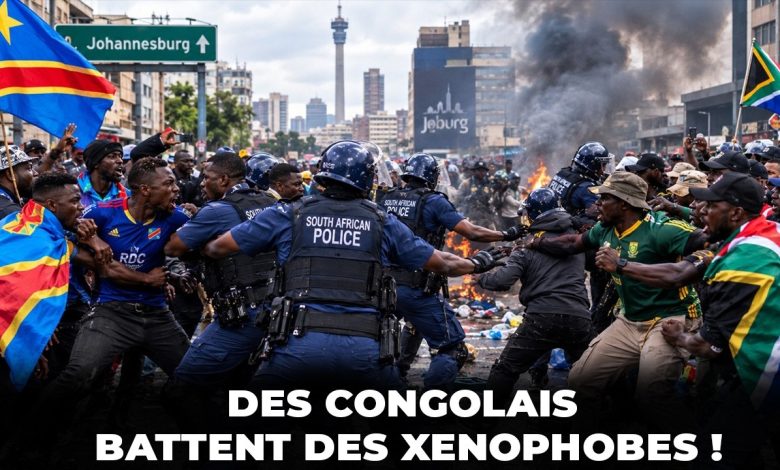
An altercation involving Congolese and South African nationals has been reported amid heightened tensions surrounding the presence of Black foreigners in South Africa. According to the available information, Congolese people temporarily staying near a police station may have confronted a group that came to the area. The situation reportedly escalated into a clash.
Several claims are circulating about the incident, including the number of people injured and the exact reasons for the confrontation. However, they do not currently make it possible to independently establish a complete timeline, a precise toll or the responsibility of each person involved.
A climate of fear for foreigners living in South Africa
The available account describes significant concern among Black foreigners living in South Africa, including Congolese nationals. Some are said to have left their homes out of fear of being targeted and gathered in public spaces near law enforcement officers in search of some form of protection.
Operations targeting homes where foreigners were believed to be living have also been mentioned. In this version of events, people were allegedly forced to leave their homes. The presence of the police reportedly prevented further violence. These elements have been reported, but it is not possible to independently verify their scale, the precise locations involved or how these operations unfolded.
The situation described serves as a reminder that foreign nationals can find themselves in highly precarious circumstances when they fear for their safety. Leaving home, sleeping outside or gathering near public institutions are often decisions made in an emergency, with direct consequences for families, children and vulnerable people.
A forced departure date mentioned but unconfirmed
The account refers to a deadline of 30 June 2026, by which Black foreigners were allegedly ordered to leave the country. This claim is presented as a central element of the tense climate. However, none of the information provided makes it possible to confirm the existence, origin or official status of such a measure.
It is therefore important to distinguish statements attributed to groups or individuals from any possible decision by the authorities. A threat, a local call to action or an initiative led by individuals does not necessarily amount to public policy. This distinction is essential for understanding the events without turning unverified statements into established information.
The altercation around a makeshift camp
The clash reportedly broke out while Congolese people were staying under tents or gathered on a public road. South Africans allegedly came to clean the area, which the occupants interpreted as an attempt to make them leave. Police reportedly asked those present to move away and not to further provoke tensions.
During this episode, a verbal dispute reportedly quickly became physical. The account refers to blows being exchanged and several South Africans being injured. Two different figures are given: 13 people injured at one point, then 11 later on. This inconsistency does not allow for a definitive toll.
The number of Congolese people involved, the condition of those injured, the severity of their injuries and any medical or legal consequences have not been reliably specified. It is therefore not possible to state that anyone was in critical condition. Caution is warranted: a violent altercation has been alleged, with injuries reported, but its exact toll remains to be established.
Claims concerning the presence of a weapon
After the clashes, a South African participant reportedly claimed that a Congolese person had a firearm and that the group had asked police to intervene. This allegation is disputed in the available account, which describes it as false. No verifiable information makes it possible to determine whether a weapon was present or whether the authorities conducted any search or check.
In a tense environment, allegations of weapon possession can very quickly increase the risk of violence. They require verification by the competent services rather than confrontations between groups. Without an official finding, it would be inaccurate to present this allegation as an established fact.
Repatriation and difficulties returning home mentioned
The account also refers to difficulties faced by some foreign nationals seeking to leave South Africa. Nigerians were reportedly invited to report to their embassy to register for repatriation. It is also claimed that flights were organised, while others remained waiting to leave.
According to this version of events, Malawian nationals chose to return by road. Ghana, for its part, is described as having organised charter flights for its nationals. This information points to differing national responses, but the arrangements, number of people concerned and timetable for these operations are not documented by the available information.
For Congolese nationals, the account refers to limited assistance, mentioning an aircraft without further details. Here again, this information does not make it possible to assess the measures actually put in place or to know how many people were able to receive support.
Avoiding generalisations and documenting the facts
Tensions between communities cannot be explained through generalisations about nationalities or ethnic groups. The account contains numerous claims about the alleged behaviour of Congolese people, Nigerians, Zulus and other populations. These are opinions and stereotypes, not demonstrated facts.
In a situation of this kind, the priority is to protect people at risk, prevent reprisals and establish individual responsibility. Violence, threats and informal expulsions particularly weaken people who have already been displaced or are unable to return to their country of origin.
The reported events above all underline the need for a calm intervention by the authorities, reliable information for the populations concerned and protection solutions for threatened foreigners. As long as the circumstances of the altercation are not confirmed by independent evidence, the toll and allegations connected to this case must be treated with caution.
Frequently Asked Questions
How many people were injured in the altercation?
Two different figures have been mentioned: 13 injured people, followed by 11. These contradictory numbers do not make it possible to confirm a precise total.
Were Congolese nationals subject to an official expulsion measure?
A forced departure date of 30 June 2026 is mentioned in the account, but none of the available information confirms that it was an official decision by the authorities.
Was a firearm present at the scene?
The presence of a weapon was alleged by a participant in the incident and disputed in the same account. It cannot be considered established without independent verification.