In South Africa, a South African woman criticizes conflations surrounding immigration

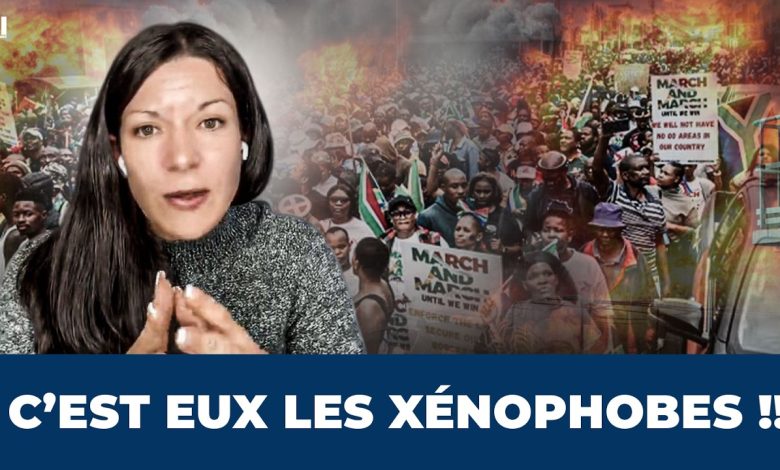
In a statement relayed by the video, she attributes part of the problem to administrative failures rather than to people waiting for documents.
The issue of immigration in South Africa is generating strong tensions in the sequence relayed by this video. The commentary refers to Black people being beaten, driven out, or humiliated, including, according to the video’s author, long-term residents and people who have known only South Africa as their place of residence.
At the centre of the excerpt, a white South African woman publicly speaks out against rhetoric and actions that indiscriminately target foreigners or people labelled as “illegal.” Her main argument is that the difficulties faced by the country should not generally be blamed on migrants. Instead, she places responsibility on the institutions responsible for processing and monitoring administrative applications.
A criticism of generalizations targeting foreigners
In the cited sequence, another speaker asks, among other things, how much the state spends on foreign nationals, referring to prisons, schools, food aid, social assistance, and hospitals. She also calls on the police to use a given day to conduct door-to-door operations against undocumented immigrants.
The South African woman responding to her criticizes this reasoning. She believes that the blanket use of the term “illegal immigrants” can lead to the inclusion of people whose situations are far more complex. She refers to a case involving Malawians: according to her, only two people in the group concerned were undocumented. Her point is therefore to challenge the drawing of a general conclusion about an entire group.
She describes this logic as xenophobic, not by denying the existence of immigration procedures, but because she considers it impossible to correctly identify each person’s situation on the basis of a collective label. In her statement, she stresses the need to distinguish people who genuinely have no right to remain from those awaiting a response from the authorities.
Document delays at the heart of her argument
The speaker draws on personal experience. She says that she submitted an application for immigration documents for her son two and a half years ago. She says that she has repeatedly gone to South Africa’s Department of Home Affairs without yet receiving the expected documents. She also says she has spent 278,000, although neither the currency nor the exact nature of this amount is specified in the excerpt.
She then asks a direct question: should her son be considered an “illegal” immigrant when the application has been submitted and is still awaiting processing? For her, the absence of an available document does not automatically mean that a person has deliberately evaded the rules.
The video’s commentary develops the same idea. It refers to visa applications submitted while people were still in regular status, but which allegedly remain blocked in the administration for months or years. According to this commentary, these delays can prevent applicants from working, opening a bank account, or normally carrying out their activities.
The video also cautiously mentions accounts of people who allegedly waited up to ten years for a residence visa. This claim is reported in the transcript without further verification. It mainly serves to illustrate the question raised: when an administration is slow to respond, who bears responsibility for the situation that follows?
According to her, the problem lies with the institutions responsible for enforcing the rules
The South African woman draws a parallel with her work in the real estate sector. She says that there are many unregistered or non-compliant practitioners in this field and that this situation harms the sector. However, she explains that she chose to take action against the authority responsible for regulating the profession rather than against individuals one by one.
According to her reasoning, the institutions that must issue documents, impose rules, and enforce them are the real bottleneck. She says that she has initiated legal proceedings against the institution concerned, while specifying that she has not yet won. She presents this approach as an alternative to mobilization directed against people identified as foreigners or undocumented.
She also states that her company now helps professionals obtain their certificates, become compliant, and register. In the excerpt, she thus contrasts two approaches: identifying individuals as the source of the problem or attempting to act on the administration and oversight mechanisms.
A warning about violence and the country’s image
The statement is not limited to administrative applications. The speaker expresses concern about the consequences of the marches and protests mentioned. She speaks of chaos, destruction, and deaths, and says she saw mothers and children trying to flee in a panicked rush. These elements are presented in her testimony and her assessment of events.
She believes that mobilizations targeting foreigners damage South Africa’s international image. She says they could affect tourism and investment, without providing figures in the excerpt. Her view is that the economic and diplomatic consequences of a climate of violence or fear go beyond the immigration issue alone.
She also challenges the slogan calling for South Africa to come before everything else. According to her, the country depends on imports and does not produce all the goods it needs. From this perspective, isolation or the stigmatization of foreigners would not be an appropriate response to national difficulties.
A political and moral debate left open by the video
The video recalls that a speaker who is regularly critical of foreigners advocates a very firm line on the departure of people in an irregular situation. The South African woman responding to her takes the opposite position: she believes that state failures should be addressed rather than the people affected by those failures.
She goes so far as to claim that violence and demonstrations weaken South Africa’s ability to defend its positions on the international stage. In the excerpt, she refers in particular to the action brought by South Africa against Israel before the International Court of Justice. This comparison reflects her personal analysis and political argument.
Finally, the commentary’s conclusion invites reflection on the notion of brotherhood: should it be reduced to skin colour or language, or associated with the willingness to protect the lives and interests of others? The transcript offers no definitive answer. Rather, it sets out a clear opposition between two interpretations: one emphasizes the expulsion of foreigners in an irregular situation; the other considers administrative delays, the lack of effective regulation, and generalizations to be at the heart of the problem.
Frequently asked questions
What is the position of the South African woman cited in the video?
She criticizes conflations targeting foreigners and undocumented people. According to her, many situations are linked to delays in processing applications by the competent institutions.
What does she criticize the authorities for?
She believes that the administrations responsible for issuing documents and enforcing the rules are not properly fulfilling their role. She says that this dysfunction places some applicants in a precarious situation.
Does the video establish that all the foreigners being targeted have an application pending?
No. The transcript does not say so. It only argues that some people labelled as “illegal” may be awaiting documents, which, according to the speaker, calls for cases to be examined individually.
Video source: watch the video on YouTube.